Readings Newsletter
Become a Readings Member to make your shopping experience even easier.
Sign in or sign up for free!
You’re not far away from qualifying for FREE standard shipping within Australia
You’ve qualified for FREE standard shipping within Australia
The cart is loading…


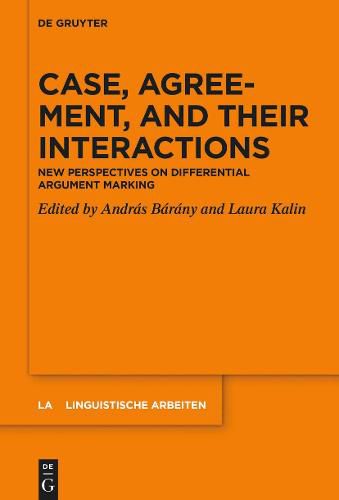
Differential argument marking has been a hot topic in linguistics for several decades, both because it is cross-linguistically widespread and because it raises essential questions at multiple levels of grammar, including the relationship between abstract processes and overt morphological marking, between case and agreement, and between syntax and information structure.
This volume provides an introduction into the current state of the art of research on differential case marking and chapters by leading linguists addressing theoretical questions in a wide range of typologically and geographically diverse languages from the Indo-European, Sinitic, Turkic, and Uralic families. The chapters engage with current theoretical issues in the morphology, syntax, semantics, and processing of differential argument marking. A central issue addressed by all the authors is the adequacy of various theoretical approaches in modelling (different varieties of) differential case marking, such as those determined by topicality, those driven by cumulative factors, and those that involve double marking.
The volume will be of interest to students and researchers working on cross-linguistic variation in differential marking and its theoretical modelling.
$9.00 standard shipping within Australia
FREE standard shipping within Australia for orders over $100.00
Express & International shipping calculated at checkout
Stock availability can be subject to change without notice. We recommend calling the shop or contacting our online team to check availability of low stock items. Please see our Shopping Online page for more details.
Differential argument marking has been a hot topic in linguistics for several decades, both because it is cross-linguistically widespread and because it raises essential questions at multiple levels of grammar, including the relationship between abstract processes and overt morphological marking, between case and agreement, and between syntax and information structure.
This volume provides an introduction into the current state of the art of research on differential case marking and chapters by leading linguists addressing theoretical questions in a wide range of typologically and geographically diverse languages from the Indo-European, Sinitic, Turkic, and Uralic families. The chapters engage with current theoretical issues in the morphology, syntax, semantics, and processing of differential argument marking. A central issue addressed by all the authors is the adequacy of various theoretical approaches in modelling (different varieties of) differential case marking, such as those determined by topicality, those driven by cumulative factors, and those that involve double marking.
The volume will be of interest to students and researchers working on cross-linguistic variation in differential marking and its theoretical modelling.
Search our extensive online catalogue.
