Readings Newsletter
Become a Readings Member to make your shopping experience even easier.
Sign in or sign up for free!
You’re not far away from qualifying for FREE standard shipping within Australia
You’ve qualified for FREE standard shipping within Australia
The cart is loading…


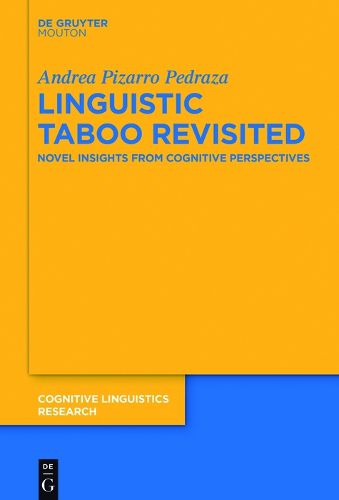
Linguistic taboo has been relegated for a long time to a peripheral position within Linguistics, due to its social stigmatization and inherent linguistic complexity. Recently, though, there has been a renewed interest in revisiting the phenomenon, especially from cognitive frameworks. This volume is the first collection of papers dealing with linguistic taboo from that perspective.
The volume gathers 15 chapters, which provide novel insights into a broad range of taboo phenomena (euphemism, dysphemism, swearing, political correctness, coprolalia, etc.) from the fields of sexuality, diseases, death, war, ageing or religion. With a special focus on lexical semantics, the authors in the volume work within Cognitive Linguistics frameworks such as conceptual metaphor and metonymy, cultural conceptualization or cognitive sociolinguistics, but also at the interface of pragmatics, discourse analysis, applied linguistics, cognitive science or psychiatry.
This volume provides theoretical reflections and case studies based on new methods and data from varied languages (English, Spanish, Polish, Dutch, Persian, Gikuyu and Egyptian Arabic). As such, it moves towards a new generation of linguistic taboo studies.
$9.00 standard shipping within Australia
FREE standard shipping within Australia for orders over $100.00
Express & International shipping calculated at checkout
Stock availability can be subject to change without notice. We recommend calling the shop or contacting our online team to check availability of low stock items. Please see our Shopping Online page for more details.
Linguistic taboo has been relegated for a long time to a peripheral position within Linguistics, due to its social stigmatization and inherent linguistic complexity. Recently, though, there has been a renewed interest in revisiting the phenomenon, especially from cognitive frameworks. This volume is the first collection of papers dealing with linguistic taboo from that perspective.
The volume gathers 15 chapters, which provide novel insights into a broad range of taboo phenomena (euphemism, dysphemism, swearing, political correctness, coprolalia, etc.) from the fields of sexuality, diseases, death, war, ageing or religion. With a special focus on lexical semantics, the authors in the volume work within Cognitive Linguistics frameworks such as conceptual metaphor and metonymy, cultural conceptualization or cognitive sociolinguistics, but also at the interface of pragmatics, discourse analysis, applied linguistics, cognitive science or psychiatry.
This volume provides theoretical reflections and case studies based on new methods and data from varied languages (English, Spanish, Polish, Dutch, Persian, Gikuyu and Egyptian Arabic). As such, it moves towards a new generation of linguistic taboo studies.
Search our extensive online catalogue.
