Readings Newsletter
Become a Readings Member to make your shopping experience even easier.
Sign in or sign up for free!
You’re not far away from qualifying for FREE standard shipping within Australia
You’ve qualified for FREE standard shipping within Australia
The cart is loading…


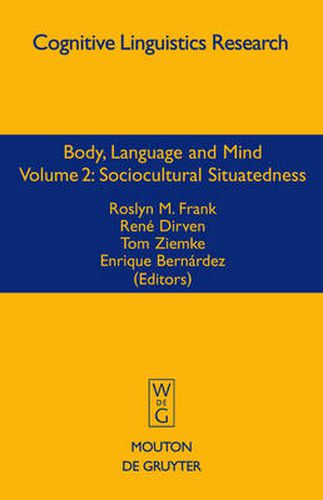
The contributions contained in the second volume of the two-volume set Body, Language and Mind introduce and elaborate upon the concept of sociocultural situatedness, understood broadly as the way in which minds and cognitive processes are shaped, both individually and collectively, by their interaction with socioculturally contextualized structures and practices; and, furthermore, how these structures interact, contextually, with language and can become embodied in it.
Drawing on theoretical concepts and analytical tools within the purview of cognitive linguistics and related fields, the volume explores the relationship between body, language and mind, focusing on the complex mutually reinforcing relationships holding between the sociocultural contextualisation of language and, inversely, the linguistic contextualisation of culure. Stated differently, the notion of sociocultural situatedness allows for language to be seen as a cultural activity and at the same time as a subtle mechanism for organizing culture and thought.
The volume offers a representative, multi- and interdisciplinary collection of new papers on sociocultural situatedness, bringing together for the first time a wide variety of perspectives and case studies directed explicitly to elucidating the analytical potential of this concept for cognitive linguists and other researchers working in allied fields such as AI, discourse studies and cognitive anthropology. The book brings together several core issues related to the notion of sociocultural situatedness, some of which have been addressed previously, although to a large degree sporadically and from a variety of disciplinary perspectives without fully exploring the possible analytical advantages of this concept as a tool for investigating the role of culturally entrenched schemata in cognition and language.
In short, this is the first comprehensive survey of sociocultural situatedness theory.
$9.00 standard shipping within Australia
FREE standard shipping within Australia for orders over $100.00
Express & International shipping calculated at checkout
Stock availability can be subject to change without notice. We recommend calling the shop or contacting our online team to check availability of low stock items. Please see our Shopping Online page for more details.
The contributions contained in the second volume of the two-volume set Body, Language and Mind introduce and elaborate upon the concept of sociocultural situatedness, understood broadly as the way in which minds and cognitive processes are shaped, both individually and collectively, by their interaction with socioculturally contextualized structures and practices; and, furthermore, how these structures interact, contextually, with language and can become embodied in it.
Drawing on theoretical concepts and analytical tools within the purview of cognitive linguistics and related fields, the volume explores the relationship between body, language and mind, focusing on the complex mutually reinforcing relationships holding between the sociocultural contextualisation of language and, inversely, the linguistic contextualisation of culure. Stated differently, the notion of sociocultural situatedness allows for language to be seen as a cultural activity and at the same time as a subtle mechanism for organizing culture and thought.
The volume offers a representative, multi- and interdisciplinary collection of new papers on sociocultural situatedness, bringing together for the first time a wide variety of perspectives and case studies directed explicitly to elucidating the analytical potential of this concept for cognitive linguists and other researchers working in allied fields such as AI, discourse studies and cognitive anthropology. The book brings together several core issues related to the notion of sociocultural situatedness, some of which have been addressed previously, although to a large degree sporadically and from a variety of disciplinary perspectives without fully exploring the possible analytical advantages of this concept as a tool for investigating the role of culturally entrenched schemata in cognition and language.
In short, this is the first comprehensive survey of sociocultural situatedness theory.
Search our extensive online catalogue.
