Readings Newsletter
Become a Readings Member to make your shopping experience even easier.
Sign in or sign up for free!
You’re not far away from qualifying for FREE standard shipping within Australia
You’ve qualified for FREE standard shipping within Australia
The cart is loading…


This title is printed to order. This book may have been self-published. If so, we cannot guarantee the quality of the content. In the main most books will have gone through the editing process however some may not. We therefore suggest that you be aware of this before ordering this book. If in doubt check either the author or publisher’s details as we are unable to accept any returns unless they are faulty. Please contact us if you have any questions.
The presence of mobile robots in diverse scenarios is considerably increasing to perform a variety of tasks. Among them, many developments have occurred in the fields of ground, underwater, and flying robotics. Independent of the environment where they move, navigation is a fundamental ability of mobile robots so that they can autonomously complete high-level tasks. This problem can be efficiently addressed through the following actions: First, it is necessary to perceive the environment in which the robot has to move, and extract some relevant information (mapping problem). Second, the robot must be able to estimate its position and orientation within this environment (localization problem). With this information, a trajectory toward the target points must be planned (path planning), and the vehicle must be reactively guided along this trajectory considering either possible changes or interactions with the environment or with the user (control). Given this information, this book introduces current frameworks in these fields (mapping, localization, path planning, and control) and, in general, approaches to any problem related to the navigation of mobile robots, such as odometry, exploration, obstacle avoidance, and simulation.
$9.00 standard shipping within Australia
FREE standard shipping within Australia for orders over $100.00
Express & International shipping calculated at checkout
Stock availability can be subject to change without notice. We recommend calling the shop or contacting our online team to check availability of low stock items. Please see our Shopping Online page for more details.
This title is printed to order. This book may have been self-published. If so, we cannot guarantee the quality of the content. In the main most books will have gone through the editing process however some may not. We therefore suggest that you be aware of this before ordering this book. If in doubt check either the author or publisher’s details as we are unable to accept any returns unless they are faulty. Please contact us if you have any questions.
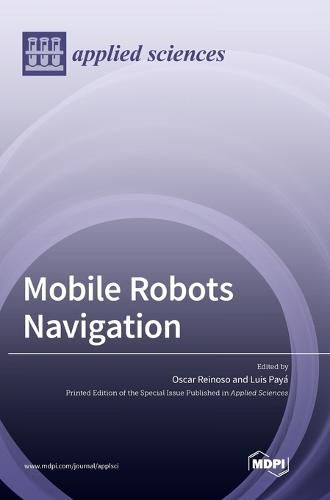
The presence of mobile robots in diverse scenarios is considerably increasing to perform a variety of tasks. Among them, many developments have occurred in the fields of ground, underwater, and flying robotics. Independent of the environment where they move, navigation is a fundamental ability of mobile robots so that they can autonomously complete high-level tasks. This problem can be efficiently addressed through the following actions: First, it is necessary to perceive the environment in which the robot has to move, and extract some relevant information (mapping problem). Second, the robot must be able to estimate its position and orientation within this environment (localization problem). With this information, a trajectory toward the target points must be planned (path planning), and the vehicle must be reactively guided along this trajectory considering either possible changes or interactions with the environment or with the user (control). Given this information, this book introduces current frameworks in these fields (mapping, localization, path planning, and control) and, in general, approaches to any problem related to the navigation of mobile robots, such as odometry, exploration, obstacle avoidance, and simulation.
Search our extensive online catalogue.
