Readings Newsletter
Become a Readings Member to make your shopping experience even easier.
Sign in or sign up for free!
You’re not far away from qualifying for FREE standard shipping within Australia
You’ve qualified for FREE standard shipping within Australia
The cart is loading…


This title is printed to order. This book may have been self-published. If so, we cannot guarantee the quality of the content. In the main most books will have gone through the editing process however some may not. We therefore suggest that you be aware of this before ordering this book. If in doubt check either the author or publisher’s details as we are unable to accept any returns unless they are faulty. Please contact us if you have any questions.
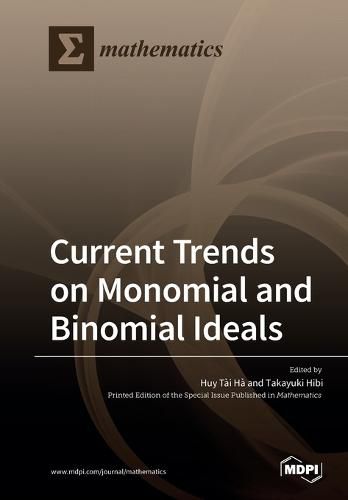
Historically, the study of monomial ideals became fashionable after the pioneering work by Richard Stanley in 1975 on the upper bound conjecture for spheres. On the other hand, since the early 1990s, under the strong influence of Groebner bases, binomial ideals became gradually fashionable in commutative algebra. The last ten years have seen a surge of research work in the study of monomial and binomial ideals. Remarkable developments in, for example, finite free resolutions, syzygies, Hilbert functions, toric rings, as well as cohomological invariants of ordinary powers, and symbolic powers of monomial and binomial ideals, have been brought forward. The theory of monomial and binomial ideals has many benefits from combinatorics and Goebner bases. Simultaneously, monomial and binomial ideals have created new and exciting aspects of combinatorics and Goebner bases. In the present Special Issue, particular attention was paid to monomial and binomial ideals arising from combinatorial objects including finite graphs, simplicial complexes, lattice polytopes, and finite partially ordered sets, because there is a rich and intimate relationship between algebraic properties and invariants of these classes of ideals and the combinatorial structures of their combinatorial counterparts. This volume gives a brief summary of recent achievements in this area of research. It will stimulate further research that encourages breakthroughs in the theory of monomial and binomial ideals. This volume provides graduate students with fundamental materials in this research area. Furthermore, it will help researchers find exciting activities and avenues for further exploration of monomial and binomial ideals. The editors express our thanks to the contributors to the Special Issue. Funds for APC (article processing charge) were partially supported by JSPS (Japan Society for the Promotion of Science) Grants-in-Aid for Scientific Research (S) entitled The Birth of Modern Trends on Commutative Algebra and Convex Polytopes with Statistical and Computational Strategies (JP 26220701). The publication of this volume is one of the main activities of the grant.
$9.00 standard shipping within Australia
FREE standard shipping within Australia for orders over $100.00
Express & International shipping calculated at checkout
Stock availability can be subject to change without notice. We recommend calling the shop or contacting our online team to check availability of low stock items. Please see our Shopping Online page for more details.
This title is printed to order. This book may have been self-published. If so, we cannot guarantee the quality of the content. In the main most books will have gone through the editing process however some may not. We therefore suggest that you be aware of this before ordering this book. If in doubt check either the author or publisher’s details as we are unable to accept any returns unless they are faulty. Please contact us if you have any questions.
Historically, the study of monomial ideals became fashionable after the pioneering work by Richard Stanley in 1975 on the upper bound conjecture for spheres. On the other hand, since the early 1990s, under the strong influence of Groebner bases, binomial ideals became gradually fashionable in commutative algebra. The last ten years have seen a surge of research work in the study of monomial and binomial ideals. Remarkable developments in, for example, finite free resolutions, syzygies, Hilbert functions, toric rings, as well as cohomological invariants of ordinary powers, and symbolic powers of monomial and binomial ideals, have been brought forward. The theory of monomial and binomial ideals has many benefits from combinatorics and Goebner bases. Simultaneously, monomial and binomial ideals have created new and exciting aspects of combinatorics and Goebner bases. In the present Special Issue, particular attention was paid to monomial and binomial ideals arising from combinatorial objects including finite graphs, simplicial complexes, lattice polytopes, and finite partially ordered sets, because there is a rich and intimate relationship between algebraic properties and invariants of these classes of ideals and the combinatorial structures of their combinatorial counterparts. This volume gives a brief summary of recent achievements in this area of research. It will stimulate further research that encourages breakthroughs in the theory of monomial and binomial ideals. This volume provides graduate students with fundamental materials in this research area. Furthermore, it will help researchers find exciting activities and avenues for further exploration of monomial and binomial ideals. The editors express our thanks to the contributors to the Special Issue. Funds for APC (article processing charge) were partially supported by JSPS (Japan Society for the Promotion of Science) Grants-in-Aid for Scientific Research (S) entitled The Birth of Modern Trends on Commutative Algebra and Convex Polytopes with Statistical and Computational Strategies (JP 26220701). The publication of this volume is one of the main activities of the grant.
Search our extensive online catalogue.
