Readings Newsletter
Become a Readings Member to make your shopping experience even easier.
Sign in or sign up for free!
You’re not far away from qualifying for FREE standard shipping within Australia
You’ve qualified for FREE standard shipping within Australia
The cart is loading…


This title is printed to order. This book may have been self-published. If so, we cannot guarantee the quality of the content. In the main most books will have gone through the editing process however some may not. We therefore suggest that you be aware of this before ordering this book. If in doubt check either the author or publisher’s details as we are unable to accept any returns unless they are faulty. Please contact us if you have any questions.
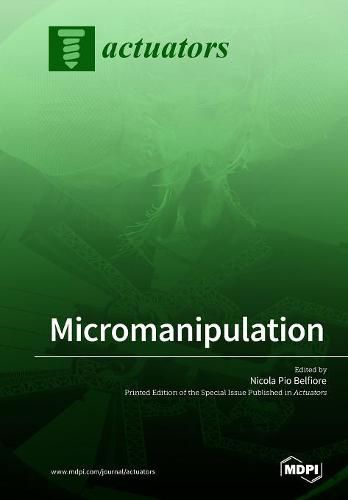
Nowadays, we meet microsystems in a variety of devices used in modern life. They are used, for example, in medicine, biology, industry, home appliances, transport, and aerospace. One of the main problems in the technological development of microsystems is their actuation. Several solutions have been suggested, such as electrostatic, electrothermal, electromagnetic, or piezoelectric actuation, although a valid solution seems to be still out of our reach.
Another crucial problem in designing, manufacturing, and operating microsystems for micromanipulation consists in the loss of some basic paradigms commonly used as a source of inspiration at the macroscale. The differences in designing at the two different scales may have either positive or negative effects. For example, an unthinkable structure in the day-life domain, as, for example, a long cantilever bridge over the Hudson river, would become possible after downscaling everything from road dimensions to the micro-world. Alternatively, a fantastic electric motor that works very well in our world, by virtue of the basic principles of electromagnetism, would become useless if scaled back to the micro cosmos.
This book opens a small window on the world of research, presenting a group of papers that try to respond to the challenge of increasing the efficiency and functionality of modern microsystems. A final little section is also dedicated to the development of new teaching methods successfully adopted in some university courses.
$9.00 standard shipping within Australia
FREE standard shipping within Australia for orders over $100.00
Express & International shipping calculated at checkout
Stock availability can be subject to change without notice. We recommend calling the shop or contacting our online team to check availability of low stock items. Please see our Shopping Online page for more details.
This title is printed to order. This book may have been self-published. If so, we cannot guarantee the quality of the content. In the main most books will have gone through the editing process however some may not. We therefore suggest that you be aware of this before ordering this book. If in doubt check either the author or publisher’s details as we are unable to accept any returns unless they are faulty. Please contact us if you have any questions.
Nowadays, we meet microsystems in a variety of devices used in modern life. They are used, for example, in medicine, biology, industry, home appliances, transport, and aerospace. One of the main problems in the technological development of microsystems is their actuation. Several solutions have been suggested, such as electrostatic, electrothermal, electromagnetic, or piezoelectric actuation, although a valid solution seems to be still out of our reach.
Another crucial problem in designing, manufacturing, and operating microsystems for micromanipulation consists in the loss of some basic paradigms commonly used as a source of inspiration at the macroscale. The differences in designing at the two different scales may have either positive or negative effects. For example, an unthinkable structure in the day-life domain, as, for example, a long cantilever bridge over the Hudson river, would become possible after downscaling everything from road dimensions to the micro-world. Alternatively, a fantastic electric motor that works very well in our world, by virtue of the basic principles of electromagnetism, would become useless if scaled back to the micro cosmos.
This book opens a small window on the world of research, presenting a group of papers that try to respond to the challenge of increasing the efficiency and functionality of modern microsystems. A final little section is also dedicated to the development of new teaching methods successfully adopted in some university courses.
Search our extensive online catalogue.
