Readings Newsletter
Become a Readings Member to make your shopping experience even easier.
Sign in or sign up for free!
You’re not far away from qualifying for FREE standard shipping within Australia
You’ve qualified for FREE standard shipping within Australia
The cart is loading…


This title is printed to order. This book may have been self-published. If so, we cannot guarantee the quality of the content. In the main most books will have gone through the editing process however some may not. We therefore suggest that you be aware of this before ordering this book. If in doubt check either the author or publisher’s details as we are unable to accept any returns unless they are faulty. Please contact us if you have any questions.
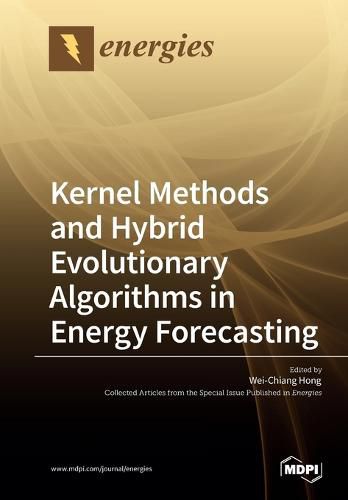
The development of kernel methods and hybrid evolutionary algorithms (HEAs) to support experts in energy forecasting is of great importance to improving the accuracy of the actions derived from an energy decision maker, and it is crucial that they are theoretically sound. In addition, more accurate or more precise energy demand forecasts are required when decisions are made in a competitive environment. Therefore, this is of special relevance in the Big Data era. These forecasts are usually based on a complex function combination. These models have resulted in over-reliance on the use of informal judgment and higher expense if lacking the ability to catch the data patterns. The novel applications of kernel methods and hybrid evolutionary algorithms can provide more satisfactory parameters in forecasting models.
We aimed to attract researchers with an interest in the research areas described above. Specifically, we were interested in contributions towards the development of HEAs with kernel methods or with other novel methods (e.g., chaotic mapping mechanism, fuzzy theory, and quantum computing mechanism), which, with superior capabilities over the traditional optimization approaches, aim to overcome some embedded drawbacks and then apply these new HEAs to be hybridized with original forecasting models to significantly improve forecasting accuracy.
$9.00 standard shipping within Australia
FREE standard shipping within Australia for orders over $100.00
Express & International shipping calculated at checkout
Stock availability can be subject to change without notice. We recommend calling the shop or contacting our online team to check availability of low stock items. Please see our Shopping Online page for more details.
This title is printed to order. This book may have been self-published. If so, we cannot guarantee the quality of the content. In the main most books will have gone through the editing process however some may not. We therefore suggest that you be aware of this before ordering this book. If in doubt check either the author or publisher’s details as we are unable to accept any returns unless they are faulty. Please contact us if you have any questions.
The development of kernel methods and hybrid evolutionary algorithms (HEAs) to support experts in energy forecasting is of great importance to improving the accuracy of the actions derived from an energy decision maker, and it is crucial that they are theoretically sound. In addition, more accurate or more precise energy demand forecasts are required when decisions are made in a competitive environment. Therefore, this is of special relevance in the Big Data era. These forecasts are usually based on a complex function combination. These models have resulted in over-reliance on the use of informal judgment and higher expense if lacking the ability to catch the data patterns. The novel applications of kernel methods and hybrid evolutionary algorithms can provide more satisfactory parameters in forecasting models.
We aimed to attract researchers with an interest in the research areas described above. Specifically, we were interested in contributions towards the development of HEAs with kernel methods or with other novel methods (e.g., chaotic mapping mechanism, fuzzy theory, and quantum computing mechanism), which, with superior capabilities over the traditional optimization approaches, aim to overcome some embedded drawbacks and then apply these new HEAs to be hybridized with original forecasting models to significantly improve forecasting accuracy.
Search our extensive online catalogue.
