Readings Newsletter
Become a Readings Member to make your shopping experience even easier.
Sign in or sign up for free!
You’re not far away from qualifying for FREE standard shipping within Australia
You’ve qualified for FREE standard shipping within Australia
The cart is loading…


This title is printed to order. This book may have been self-published. If so, we cannot guarantee the quality of the content. In the main most books will have gone through the editing process however some may not. We therefore suggest that you be aware of this before ordering this book. If in doubt check either the author or publisher’s details as we are unable to accept any returns unless they are faulty. Please contact us if you have any questions.
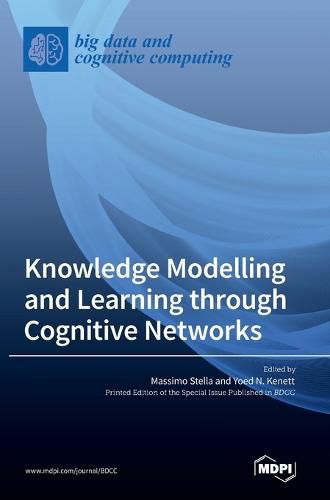
One of the most promising developments in modelling knowledge is cognitive network science, which aims to investigate cognitive phenomena driven by the networked, associative organization of knowledge. For example, investigating the structure of semantic memory via semantic networks has illuminated how memory recall patterns influence phenomena such as creativity, memory search, learning, and more generally, knowledge acquisition, exploration, and exploitation. In parallel, neural network models for artificial intelligence (AI) are also becoming more widespread as inferential models for understanding which features drive language-related phenomena such as meaning reconstruction, stance detection, and emotional profiling. Whereas cognitive networks map explicitly which entities engage in associative relationships, neural networks perform an implicit mapping of correlations in cognitive data as weights, obtained after training over labelled data and whose interpretation is not immediately evident to the experimenter. This book aims to bring together quantitative, innovative research that focuses on modelling knowledge through cognitive and neural networks to gain insight into mechanisms driving cognitive processes related to knowledge structuring, exploration, and learning. The book comprises a variety of publication types, including reviews and theoretical papers, empirical research, computational modelling, and big data analysis. All papers here share a commonality: they demonstrate how the application of network science and AI can extend and broaden cognitive science in ways that traditional approaches cannot.
$9.00 standard shipping within Australia
FREE standard shipping within Australia for orders over $100.00
Express & International shipping calculated at checkout
Stock availability can be subject to change without notice. We recommend calling the shop or contacting our online team to check availability of low stock items. Please see our Shopping Online page for more details.
This title is printed to order. This book may have been self-published. If so, we cannot guarantee the quality of the content. In the main most books will have gone through the editing process however some may not. We therefore suggest that you be aware of this before ordering this book. If in doubt check either the author or publisher’s details as we are unable to accept any returns unless they are faulty. Please contact us if you have any questions.
One of the most promising developments in modelling knowledge is cognitive network science, which aims to investigate cognitive phenomena driven by the networked, associative organization of knowledge. For example, investigating the structure of semantic memory via semantic networks has illuminated how memory recall patterns influence phenomena such as creativity, memory search, learning, and more generally, knowledge acquisition, exploration, and exploitation. In parallel, neural network models for artificial intelligence (AI) are also becoming more widespread as inferential models for understanding which features drive language-related phenomena such as meaning reconstruction, stance detection, and emotional profiling. Whereas cognitive networks map explicitly which entities engage in associative relationships, neural networks perform an implicit mapping of correlations in cognitive data as weights, obtained after training over labelled data and whose interpretation is not immediately evident to the experimenter. This book aims to bring together quantitative, innovative research that focuses on modelling knowledge through cognitive and neural networks to gain insight into mechanisms driving cognitive processes related to knowledge structuring, exploration, and learning. The book comprises a variety of publication types, including reviews and theoretical papers, empirical research, computational modelling, and big data analysis. All papers here share a commonality: they demonstrate how the application of network science and AI can extend and broaden cognitive science in ways that traditional approaches cannot.
Search our extensive online catalogue.
