Readings Newsletter
Become a Readings Member to make your shopping experience even easier.
Sign in or sign up for free!
You’re not far away from qualifying for FREE standard shipping within Australia
You’ve qualified for FREE standard shipping within Australia
The cart is loading…


This title is printed to order. This book may have been self-published. If so, we cannot guarantee the quality of the content. In the main most books will have gone through the editing process however some may not. We therefore suggest that you be aware of this before ordering this book. If in doubt check either the author or publisher’s details as we are unable to accept any returns unless they are faulty. Please contact us if you have any questions.
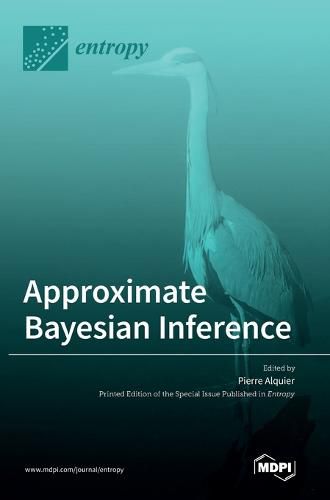
Extremely popular for statistical inference, Bayesian methods are also becoming popular in machine learning and artificial intelligence problems. Bayesian estimators are often implemented by Monte Carlo methods, such as the Metropolis-Hastings algorithm of the Gibbs sampler. These algorithms target the exact posterior distribution. However, many of the modern models in statistics are simply too complex to use such methodologies. In machine learning, the volume of the data used in practice makes Monte Carlo methods too slow to be useful. On the other hand, these applications often do not require an exact knowledge of the posterior. This has motivated the development of a new generation of algorithms that are fast enough to handle huge datasets but that often target an approximation of the posterior. This book gathers 18 research papers written by Approximate Bayesian Inference specialists and provides an overview of the recent advances in these algorithms. This includes optimization-based methods (such as variational approximations) and simulation-based methods (such as ABC or Monte Carlo algorithms). The theoretical aspects of Approximate Bayesian Inference are covered, specifically the PAC-Bayes bounds and regret analysis. Applications for challenging computational problems in astrophysics, finance, medical data analysis, and computer vision area also presented.
$9.00 standard shipping within Australia
FREE standard shipping within Australia for orders over $100.00
Express & International shipping calculated at checkout
Stock availability can be subject to change without notice. We recommend calling the shop or contacting our online team to check availability of low stock items. Please see our Shopping Online page for more details.
This title is printed to order. This book may have been self-published. If so, we cannot guarantee the quality of the content. In the main most books will have gone through the editing process however some may not. We therefore suggest that you be aware of this before ordering this book. If in doubt check either the author or publisher’s details as we are unable to accept any returns unless they are faulty. Please contact us if you have any questions.
Extremely popular for statistical inference, Bayesian methods are also becoming popular in machine learning and artificial intelligence problems. Bayesian estimators are often implemented by Monte Carlo methods, such as the Metropolis-Hastings algorithm of the Gibbs sampler. These algorithms target the exact posterior distribution. However, many of the modern models in statistics are simply too complex to use such methodologies. In machine learning, the volume of the data used in practice makes Monte Carlo methods too slow to be useful. On the other hand, these applications often do not require an exact knowledge of the posterior. This has motivated the development of a new generation of algorithms that are fast enough to handle huge datasets but that often target an approximation of the posterior. This book gathers 18 research papers written by Approximate Bayesian Inference specialists and provides an overview of the recent advances in these algorithms. This includes optimization-based methods (such as variational approximations) and simulation-based methods (such as ABC or Monte Carlo algorithms). The theoretical aspects of Approximate Bayesian Inference are covered, specifically the PAC-Bayes bounds and regret analysis. Applications for challenging computational problems in astrophysics, finance, medical data analysis, and computer vision area also presented.
Search our extensive online catalogue.
