Readings Newsletter
Become a Readings Member to make your shopping experience even easier.
Sign in or sign up for free!
You’re not far away from qualifying for FREE standard shipping within Australia
You’ve qualified for FREE standard shipping within Australia
The cart is loading…


This title is printed to order. This book may have been self-published. If so, we cannot guarantee the quality of the content. In the main most books will have gone through the editing process however some may not. We therefore suggest that you be aware of this before ordering this book. If in doubt check either the author or publisher’s details as we are unable to accept any returns unless they are faulty. Please contact us if you have any questions.
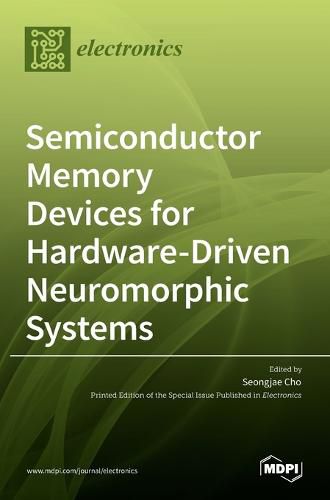
This book aims to convey the most recent progress in hardware-driven neuromorphic systems based on semiconductor memory technologies. Machine learning systems and various types of artificial neural networks to realize the learning process have mainly focused on software technologies. Tremendous advances have been made, particularly in the area of data inference and recognition, in which humans have great superiority compared to conventional computers. In order to more effectively mimic our way of thinking in a further hardware sense, more synapse-like components in terms of
integration density, completeness in realizing biological synaptic behaviors, and most importantly, energy-efficient operation capability, should be prepared. For higher resemblance with the biological nervous system, future developments ought to take power consumption into account and foster revolutions at the device level, which can be realized by memory technologies. This book consists of seven articles in which most recent research findings on neuromorphic systems are reported in the highlights of various memory devices and architectures. Synaptic devices and their behaviors, manycore neuromorphic platforms in close relation with memory, novel materials enabling the low-power synaptic operations based on memory devices are studied, along with evaluations and applications. Some of them can be practically realized due to high Si processing and structure compatibility with contemporary semiconductor memory technologies in production, which provides perspectives of neuromorphic chips for mass production.
$9.00 standard shipping within Australia
FREE standard shipping within Australia for orders over $100.00
Express & International shipping calculated at checkout
Stock availability can be subject to change without notice. We recommend calling the shop or contacting our online team to check availability of low stock items. Please see our Shopping Online page for more details.
This title is printed to order. This book may have been self-published. If so, we cannot guarantee the quality of the content. In the main most books will have gone through the editing process however some may not. We therefore suggest that you be aware of this before ordering this book. If in doubt check either the author or publisher’s details as we are unable to accept any returns unless they are faulty. Please contact us if you have any questions.
This book aims to convey the most recent progress in hardware-driven neuromorphic systems based on semiconductor memory technologies. Machine learning systems and various types of artificial neural networks to realize the learning process have mainly focused on software technologies. Tremendous advances have been made, particularly in the area of data inference and recognition, in which humans have great superiority compared to conventional computers. In order to more effectively mimic our way of thinking in a further hardware sense, more synapse-like components in terms of
integration density, completeness in realizing biological synaptic behaviors, and most importantly, energy-efficient operation capability, should be prepared. For higher resemblance with the biological nervous system, future developments ought to take power consumption into account and foster revolutions at the device level, which can be realized by memory technologies. This book consists of seven articles in which most recent research findings on neuromorphic systems are reported in the highlights of various memory devices and architectures. Synaptic devices and their behaviors, manycore neuromorphic platforms in close relation with memory, novel materials enabling the low-power synaptic operations based on memory devices are studied, along with evaluations and applications. Some of them can be practically realized due to high Si processing and structure compatibility with contemporary semiconductor memory technologies in production, which provides perspectives of neuromorphic chips for mass production.
Search our extensive online catalogue.
