Readings Newsletter
Become a Readings Member to make your shopping experience even easier.
Sign in or sign up for free!
You’re not far away from qualifying for FREE standard shipping within Australia
You’ve qualified for FREE standard shipping within Australia
The cart is loading…


This title is printed to order. This book may have been self-published. If so, we cannot guarantee the quality of the content. In the main most books will have gone through the editing process however some may not. We therefore suggest that you be aware of this before ordering this book. If in doubt check either the author or publisher’s details as we are unable to accept any returns unless they are faulty. Please contact us if you have any questions.
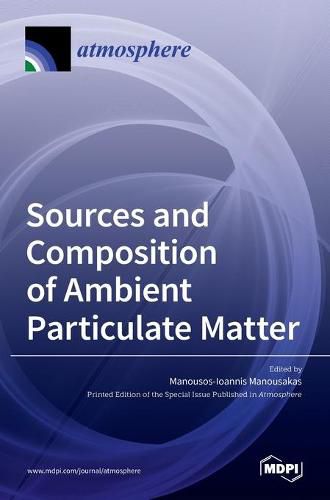
Research related to ambient particulate matter (PM) remains very relevant today due to the adverse effects that PM have on human health. PM are pollutants with varying chemical compositions and may originate from multiple emission sources, which directly affects their toxicity. To formulate effective control and mitigation strategies, it is necessary to identify PM sources and to estimate their influence on ambient PM concentration, a process that is known as source apportionment (SA). Depending on the geographical location and characteristics of an area, many anthropogenic and natural sources may contribute to PM concentration levels, such as dust resuspension, sea salt, traffic, secondary aerosol formation, industrial emissions, ship emissions, biomass burning, power plant emissions, etc. Different methodological approaches have been used over the years to study the aforementioned topics, but some scientific challenges remain, mainly related to the following subjects: real-time chemical analysis and SA, uncertainty estimation of SA results, and analytical optimization for PM samples. Additionally, there are areas in the world for which the results regarding composition and sources of PM are still scarce. The objective of this collection was to include studies on all aspects of PM chemical characterization and source apportionment regarding the inorganic and/or organic fractions of PM.
$9.00 standard shipping within Australia
FREE standard shipping within Australia for orders over $100.00
Express & International shipping calculated at checkout
Stock availability can be subject to change without notice. We recommend calling the shop or contacting our online team to check availability of low stock items. Please see our Shopping Online page for more details.
This title is printed to order. This book may have been self-published. If so, we cannot guarantee the quality of the content. In the main most books will have gone through the editing process however some may not. We therefore suggest that you be aware of this before ordering this book. If in doubt check either the author or publisher’s details as we are unable to accept any returns unless they are faulty. Please contact us if you have any questions.
Research related to ambient particulate matter (PM) remains very relevant today due to the adverse effects that PM have on human health. PM are pollutants with varying chemical compositions and may originate from multiple emission sources, which directly affects their toxicity. To formulate effective control and mitigation strategies, it is necessary to identify PM sources and to estimate their influence on ambient PM concentration, a process that is known as source apportionment (SA). Depending on the geographical location and characteristics of an area, many anthropogenic and natural sources may contribute to PM concentration levels, such as dust resuspension, sea salt, traffic, secondary aerosol formation, industrial emissions, ship emissions, biomass burning, power plant emissions, etc. Different methodological approaches have been used over the years to study the aforementioned topics, but some scientific challenges remain, mainly related to the following subjects: real-time chemical analysis and SA, uncertainty estimation of SA results, and analytical optimization for PM samples. Additionally, there are areas in the world for which the results regarding composition and sources of PM are still scarce. The objective of this collection was to include studies on all aspects of PM chemical characterization and source apportionment regarding the inorganic and/or organic fractions of PM.
Search our extensive online catalogue.
