Readings Newsletter
Become a Readings Member to make your shopping experience even easier.
Sign in or sign up for free!
You’re not far away from qualifying for FREE standard shipping within Australia
You’ve qualified for FREE standard shipping within Australia
The cart is loading…


This title is printed to order. This book may have been self-published. If so, we cannot guarantee the quality of the content. In the main most books will have gone through the editing process however some may not. We therefore suggest that you be aware of this before ordering this book. If in doubt check either the author or publisher’s details as we are unable to accept any returns unless they are faulty. Please contact us if you have any questions.
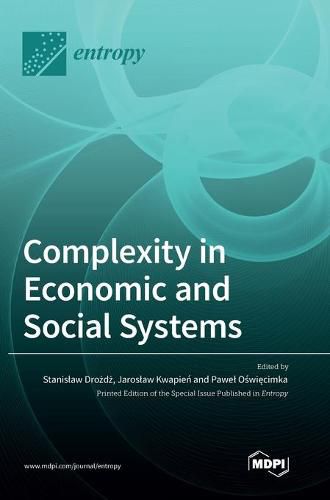
There is no term that better describes the essential features of human society than complexity. On various levels, from the decision-making processes of individuals, through to the interactions between individuals leading to the spontaneous formation of groups and social hierarchies, up to the collective, herding processes that reshape whole societies, all these features share the property of irreducibility, i.e., they require a holistic, multi-level approach formed by researchers from different disciplines. This Special Issue aims to collect research studies that, by exploiting the latest advances in physics, economics, complex networks, and data science, make a step towards understanding these economic and social systems. The majority of submissions are devoted to financial market analysis and modeling, including the stock and cryptocurrency markets in the COVID-19 pandemic, systemic risk quantification and control, wealth condensation, the innovation-related performance of companies, and more. Looking more at societies, there are papers that deal with regional development, land speculation, and the-fake news-fighting strategies, the issues which are of central interest in contemporary society. On top of this, one of the contributions proposes a new, improved complexity measure.
$9.00 standard shipping within Australia
FREE standard shipping within Australia for orders over $100.00
Express & International shipping calculated at checkout
Stock availability can be subject to change without notice. We recommend calling the shop or contacting our online team to check availability of low stock items. Please see our Shopping Online page for more details.
This title is printed to order. This book may have been self-published. If so, we cannot guarantee the quality of the content. In the main most books will have gone through the editing process however some may not. We therefore suggest that you be aware of this before ordering this book. If in doubt check either the author or publisher’s details as we are unable to accept any returns unless they are faulty. Please contact us if you have any questions.
There is no term that better describes the essential features of human society than complexity. On various levels, from the decision-making processes of individuals, through to the interactions between individuals leading to the spontaneous formation of groups and social hierarchies, up to the collective, herding processes that reshape whole societies, all these features share the property of irreducibility, i.e., they require a holistic, multi-level approach formed by researchers from different disciplines. This Special Issue aims to collect research studies that, by exploiting the latest advances in physics, economics, complex networks, and data science, make a step towards understanding these economic and social systems. The majority of submissions are devoted to financial market analysis and modeling, including the stock and cryptocurrency markets in the COVID-19 pandemic, systemic risk quantification and control, wealth condensation, the innovation-related performance of companies, and more. Looking more at societies, there are papers that deal with regional development, land speculation, and the-fake news-fighting strategies, the issues which are of central interest in contemporary society. On top of this, one of the contributions proposes a new, improved complexity measure.
Search our extensive online catalogue.
