Readings Newsletter
Become a Readings Member to make your shopping experience even easier.
Sign in or sign up for free!
You’re not far away from qualifying for FREE standard shipping within Australia
You’ve qualified for FREE standard shipping within Australia
The cart is loading…


This title is printed to order. This book may have been self-published. If so, we cannot guarantee the quality of the content. In the main most books will have gone through the editing process however some may not. We therefore suggest that you be aware of this before ordering this book. If in doubt check either the author or publisher’s details as we are unable to accept any returns unless they are faulty. Please contact us if you have any questions.
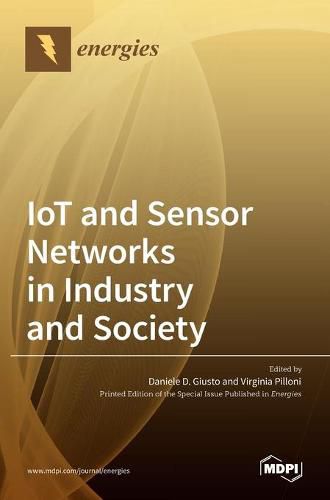
In the last decade, the deployment of Internet of Things (IoT) and sensor networks have made a strong impact on many aspects of society. The seamless integration of technologies to perform sensor data generation, transmission, and processing has enabled the development of smart solutions such as smart cities, smart agriculture, and smart transports. As the business environment is being increasingly digitized, traditional industrial processes are rapidly reshaping to build the fourth industrial revolution, namely Industry 4.0. This will pave the way for the use of information and communication technology (ICT) as one of the pillars of Society 5.0, a super-smart human-centric society in which both economic development and resolution of societal challenges are achieved. This book presents recent advances in IoT and sensor networks towards the implementation of Industry 4.0 and Society 5.0. The 12 Chapters cover some of the most relevant aspects, starting from a horizontal view of the main enabling technologies, and proceeding with a vertical perspective on four different environments, namely Industry 4.0, smart buildings, smart transport, and smart environmental monitoring. Researchers and practitioners will find this book a valuable tool for their work, helping them evaluate the different technologies that will have a key role in the progress of industry and society, while understanding their inherent strengths and drawbacks.
$9.00 standard shipping within Australia
FREE standard shipping within Australia for orders over $100.00
Express & International shipping calculated at checkout
Stock availability can be subject to change without notice. We recommend calling the shop or contacting our online team to check availability of low stock items. Please see our Shopping Online page for more details.
This title is printed to order. This book may have been self-published. If so, we cannot guarantee the quality of the content. In the main most books will have gone through the editing process however some may not. We therefore suggest that you be aware of this before ordering this book. If in doubt check either the author or publisher’s details as we are unable to accept any returns unless they are faulty. Please contact us if you have any questions.
In the last decade, the deployment of Internet of Things (IoT) and sensor networks have made a strong impact on many aspects of society. The seamless integration of technologies to perform sensor data generation, transmission, and processing has enabled the development of smart solutions such as smart cities, smart agriculture, and smart transports. As the business environment is being increasingly digitized, traditional industrial processes are rapidly reshaping to build the fourth industrial revolution, namely Industry 4.0. This will pave the way for the use of information and communication technology (ICT) as one of the pillars of Society 5.0, a super-smart human-centric society in which both economic development and resolution of societal challenges are achieved. This book presents recent advances in IoT and sensor networks towards the implementation of Industry 4.0 and Society 5.0. The 12 Chapters cover some of the most relevant aspects, starting from a horizontal view of the main enabling technologies, and proceeding with a vertical perspective on four different environments, namely Industry 4.0, smart buildings, smart transport, and smart environmental monitoring. Researchers and practitioners will find this book a valuable tool for their work, helping them evaluate the different technologies that will have a key role in the progress of industry and society, while understanding their inherent strengths and drawbacks.
Search our extensive online catalogue.
