Readings Newsletter
Become a Readings Member to make your shopping experience even easier.
Sign in or sign up for free!
You’re not far away from qualifying for FREE standard shipping within Australia
You’ve qualified for FREE standard shipping within Australia
The cart is loading…


This title is printed to order. This book may have been self-published. If so, we cannot guarantee the quality of the content. In the main most books will have gone through the editing process however some may not. We therefore suggest that you be aware of this before ordering this book. If in doubt check either the author or publisher’s details as we are unable to accept any returns unless they are faulty. Please contact us if you have any questions.
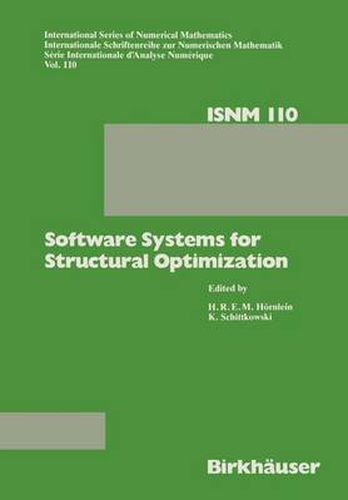
Herbert Hornlein, Klaus Schittkowski The finite element method (FEM) has been used successfully for many years to simulate and analyse mechanical structural problems. The results are accepted or rejected by means of comparison of state variables (stresses, displacements, natural frequencies etc.) and user requirements. In further analyses the design variables will be updated until the user specifications are met and the design is feasible. This is the primary aim of the design process. On this set of feasible designs, the additional requirement given by an objective function (e.g. weight, stiffness, efficiency, etc.) defines the structural optimization problem. In recent years more and more finite element based analysis systems were ex tended and offer now optimization modules. They proceed from the design model as defined for structural analysis, to perform an internal adaption of design pa rameters based on formal mathematical methods. Despite of many common features, there are significant differences in the selected optimization strategy, the current implementation and the numerical results.
$9.00 standard shipping within Australia
FREE standard shipping within Australia for orders over $100.00
Express & International shipping calculated at checkout
Stock availability can be subject to change without notice. We recommend calling the shop or contacting our online team to check availability of low stock items. Please see our Shopping Online page for more details.
This title is printed to order. This book may have been self-published. If so, we cannot guarantee the quality of the content. In the main most books will have gone through the editing process however some may not. We therefore suggest that you be aware of this before ordering this book. If in doubt check either the author or publisher’s details as we are unable to accept any returns unless they are faulty. Please contact us if you have any questions.
Herbert Hornlein, Klaus Schittkowski The finite element method (FEM) has been used successfully for many years to simulate and analyse mechanical structural problems. The results are accepted or rejected by means of comparison of state variables (stresses, displacements, natural frequencies etc.) and user requirements. In further analyses the design variables will be updated until the user specifications are met and the design is feasible. This is the primary aim of the design process. On this set of feasible designs, the additional requirement given by an objective function (e.g. weight, stiffness, efficiency, etc.) defines the structural optimization problem. In recent years more and more finite element based analysis systems were ex tended and offer now optimization modules. They proceed from the design model as defined for structural analysis, to perform an internal adaption of design pa rameters based on formal mathematical methods. Despite of many common features, there are significant differences in the selected optimization strategy, the current implementation and the numerical results.
Search our extensive online catalogue.
