Readings Newsletter
Become a Readings Member to make your shopping experience even easier.
Sign in or sign up for free!
You’re not far away from qualifying for FREE standard shipping within Australia
You’ve qualified for FREE standard shipping within Australia
The cart is loading…


This title is printed to order. This book may have been self-published. If so, we cannot guarantee the quality of the content. In the main most books will have gone through the editing process however some may not. We therefore suggest that you be aware of this before ordering this book. If in doubt check either the author or publisher’s details as we are unable to accept any returns unless they are faulty. Please contact us if you have any questions.
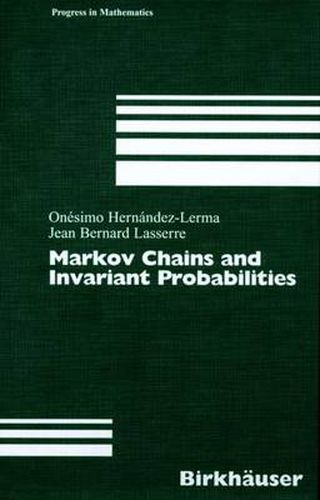
This book is about discrete-time, time-homogeneous, Markov chains (Mes) and their ergodic behavior. To this end, most of the material is in fact about stable Mes, by which we mean Mes that admit an invariant probability measure. To state this more precisely and give an overview of the questions we shall be dealing with, we will first introduce some notation and terminology. Let (X,B) be a measurable space, and consider a X-valued Markov chain ~. = {~k’ k = 0, 1, … } with transition probability function (t.pJ.) P(x, B), i.e., P(x, B) := Prob (~k+1 E B I ~k = x) for each x E X, B E B, and k = 0,1, …. The Me ~. is said to be stable if there exists a probability measure (p.m.) /.l on B such that (*) VB EB. /.l(B) = Ix /.l(dx) P(x, B) If (*) holds then /.l is called an invariant p.m. for the Me ~. (or the t.p.f. P).
$9.00 standard shipping within Australia
FREE standard shipping within Australia for orders over $100.00
Express & International shipping calculated at checkout
Stock availability can be subject to change without notice. We recommend calling the shop or contacting our online team to check availability of low stock items. Please see our Shopping Online page for more details.
This title is printed to order. This book may have been self-published. If so, we cannot guarantee the quality of the content. In the main most books will have gone through the editing process however some may not. We therefore suggest that you be aware of this before ordering this book. If in doubt check either the author or publisher’s details as we are unable to accept any returns unless they are faulty. Please contact us if you have any questions.
This book is about discrete-time, time-homogeneous, Markov chains (Mes) and their ergodic behavior. To this end, most of the material is in fact about stable Mes, by which we mean Mes that admit an invariant probability measure. To state this more precisely and give an overview of the questions we shall be dealing with, we will first introduce some notation and terminology. Let (X,B) be a measurable space, and consider a X-valued Markov chain ~. = {~k’ k = 0, 1, … } with transition probability function (t.pJ.) P(x, B), i.e., P(x, B) := Prob (~k+1 E B I ~k = x) for each x E X, B E B, and k = 0,1, …. The Me ~. is said to be stable if there exists a probability measure (p.m.) /.l on B such that (*) VB EB. /.l(B) = Ix /.l(dx) P(x, B) If (*) holds then /.l is called an invariant p.m. for the Me ~. (or the t.p.f. P).
Search our extensive online catalogue.
