Readings Newsletter
Become a Readings Member to make your shopping experience even easier.
Sign in or sign up for free!
You’re not far away from qualifying for FREE standard shipping within Australia
You’ve qualified for FREE standard shipping within Australia
The cart is loading…


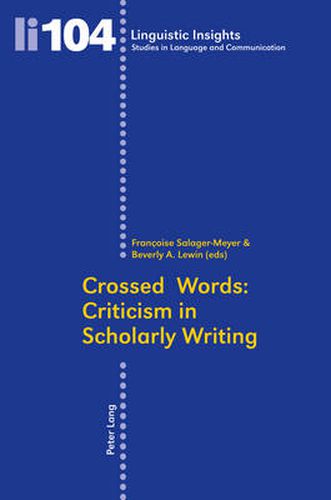
In order for science to advance, previous research findings must be reviewed and criticized. However, conveying criticism is particularly difficult for scientists who must, at the same time, try to maintain an impersonal stance. This co-edited collection of independent studies written by scholars from many different countries addresses the thorny issue of criticism in science through discourse analysis of written scientific texts.
The research reported in this volume deals with questions such as: 1) how criticism is conveyed by various linguistic communities, such as Serbian, French, Spanish, German and English; 2) how criticism is handled in various genres, with examples drawn from book reviews, referees’ reports, research articles, editorials, and review/meta-analysis papers; 3) the extent to which criticism is influenced by academic discipline, with findings from linguistics, economics, biology, business, musicology, chemistry, literary research, medicine, and physics, and 4) the impact interpersonal considerations have on the linguistic realization of criticism.
The conclusions reached by these contributions have implications for both the academic world and society at large in the sense that a fuller understanding of how criticism is expressed will help in the education of future scholars and in the understanding of the social construction of knowledge.
$9.00 standard shipping within Australia
FREE standard shipping within Australia for orders over $100.00
Express & International shipping calculated at checkout
In order for science to advance, previous research findings must be reviewed and criticized. However, conveying criticism is particularly difficult for scientists who must, at the same time, try to maintain an impersonal stance. This co-edited collection of independent studies written by scholars from many different countries addresses the thorny issue of criticism in science through discourse analysis of written scientific texts.
The research reported in this volume deals with questions such as: 1) how criticism is conveyed by various linguistic communities, such as Serbian, French, Spanish, German and English; 2) how criticism is handled in various genres, with examples drawn from book reviews, referees’ reports, research articles, editorials, and review/meta-analysis papers; 3) the extent to which criticism is influenced by academic discipline, with findings from linguistics, economics, biology, business, musicology, chemistry, literary research, medicine, and physics, and 4) the impact interpersonal considerations have on the linguistic realization of criticism.
The conclusions reached by these contributions have implications for both the academic world and society at large in the sense that a fuller understanding of how criticism is expressed will help in the education of future scholars and in the understanding of the social construction of knowledge.
Search our extensive online catalogue.
