Readings Newsletter
Become a Readings Member to make your shopping experience even easier.
Sign in or sign up for free!
You’re not far away from qualifying for FREE standard shipping within Australia
You’ve qualified for FREE standard shipping within Australia
The cart is loading…


This title is printed to order. This book may have been self-published. If so, we cannot guarantee the quality of the content. In the main most books will have gone through the editing process however some may not. We therefore suggest that you be aware of this before ordering this book. If in doubt check either the author or publisher’s details as we are unable to accept any returns unless they are faulty. Please contact us if you have any questions.
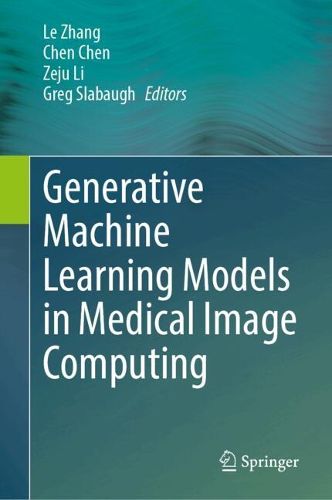
Generative Machine Learning Models in Medical Image Computing" provides a comprehensive exploration of generative modeling techniques tailored to the unique demands of medical imaging. This book presents an in-depth overview of cutting-edge generative models such as GANs, VAEs, and diffusion models, examining how they enable groundbreaking applications in medical image synthesis, reconstruction, and enhancement. Covering diverse imaging modalities like MRI, CT, and ultrasound, it illustrates how these models facilitate improvements in image quality, support data augmentation for scarce datasets, and create new avenues for predictive diagnostics.
Beyond technical details, the book addresses critical challenges in deploying generative models for healthcare, including ethical concerns, interpretability, and clinical validation. With a strong focus on real-world applications, it includes case studies and implementation guidelines, guiding readers in translating theory into practice. By addressing model robustness, reproducibility, and clinical utility, this book is an essential resource for researchers, clinicians, and data scientists seeking to leverage generative models to enhance biomedical imaging and deliver impactful healthcare solutions. Combining technical rigor with practical insights, it offers a roadmap for integrating advanced generative approaches in the field of medical image computing.
$9.00 standard shipping within Australia
FREE standard shipping within Australia for orders over $100.00
Express & International shipping calculated at checkout
Stock availability can be subject to change without notice. We recommend calling the shop or contacting our online team to check availability of low stock items. Please see our Shopping Online page for more details.
This title is printed to order. This book may have been self-published. If so, we cannot guarantee the quality of the content. In the main most books will have gone through the editing process however some may not. We therefore suggest that you be aware of this before ordering this book. If in doubt check either the author or publisher’s details as we are unable to accept any returns unless they are faulty. Please contact us if you have any questions.
Generative Machine Learning Models in Medical Image Computing" provides a comprehensive exploration of generative modeling techniques tailored to the unique demands of medical imaging. This book presents an in-depth overview of cutting-edge generative models such as GANs, VAEs, and diffusion models, examining how they enable groundbreaking applications in medical image synthesis, reconstruction, and enhancement. Covering diverse imaging modalities like MRI, CT, and ultrasound, it illustrates how these models facilitate improvements in image quality, support data augmentation for scarce datasets, and create new avenues for predictive diagnostics.
Beyond technical details, the book addresses critical challenges in deploying generative models for healthcare, including ethical concerns, interpretability, and clinical validation. With a strong focus on real-world applications, it includes case studies and implementation guidelines, guiding readers in translating theory into practice. By addressing model robustness, reproducibility, and clinical utility, this book is an essential resource for researchers, clinicians, and data scientists seeking to leverage generative models to enhance biomedical imaging and deliver impactful healthcare solutions. Combining technical rigor with practical insights, it offers a roadmap for integrating advanced generative approaches in the field of medical image computing.
Search our extensive online catalogue.
