Readings Newsletter
Become a Readings Member to make your shopping experience even easier.
Sign in or sign up for free!
You’re not far away from qualifying for FREE standard shipping within Australia
You’ve qualified for FREE standard shipping within Australia
The cart is loading…


This title is printed to order. This book may have been self-published. If so, we cannot guarantee the quality of the content. In the main most books will have gone through the editing process however some may not. We therefore suggest that you be aware of this before ordering this book. If in doubt check either the author or publisher’s details as we are unable to accept any returns unless they are faulty. Please contact us if you have any questions.
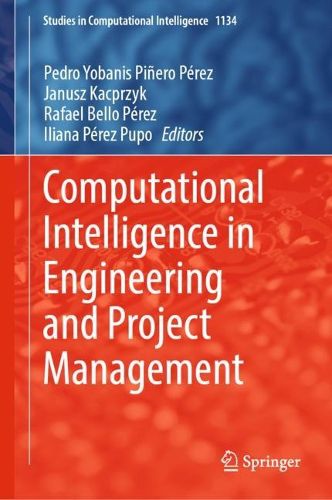
This book is dedicated to all those interested in the application of artificial intelligence in engineering and project management. Most of the jobs are focused on achieving agile project development. New algorithms that combine various computational intelligence techniques are applied in different areas of knowledge in project management.
In this book, computational intelligence is presented as the branch of AI that encompasses various techniques aimed at simulating human tolerance in decision-making processes in environments with uncertainty and imprecision. Among the precursor techniques of computational intelligence are: evolutionary algorithms, artificial neural networks, fuzzy set theory, and fuzzy systems. However, other areas such as the rough set, linguistic data summary, natural language processing, the conversational systems, fuzzy cognitive maps, collective intelligence, the neutrosophic theory, and other fuzzy logic extensions are contributing to the application and extension of computational intelligence
The book is organized into three parts, as shown below. The first part constitutes a critical review of computational intelligence in project management. The second part presents new computational intelligence techniques and their applications in project planning, control, and monitoring processes. In particular, the use of conversational systems and their applicability in the agile management of portfolio programs and projects stand out. Part three of the book exemplifies the use of computing techniques with words and other computational intelligence techniques for organizational decision-making.
The authors of the book stand out for their extensive experience in the development of basic and applied applications of computational intelligence. The authors Janusz Kacprzyk, Pedro Y. Pinero Perez, Rafael E. Bello Perez, and Iliana Perez Pupo have published several books associated with artificial intelligence and computational intelligence applied to projects. They continue working on fundamental-oriented and applied research on different artificial intelligence techniques to help with decision-making in different areas of knowledge.
Authors would like to thank all the engineers, professors, and researchers without whose efforts this book could not have been written.
$9.00 standard shipping within Australia
FREE standard shipping within Australia for orders over $100.00
Express & International shipping calculated at checkout
Stock availability can be subject to change without notice. We recommend calling the shop or contacting our online team to check availability of low stock items. Please see our Shopping Online page for more details.
This title is printed to order. This book may have been self-published. If so, we cannot guarantee the quality of the content. In the main most books will have gone through the editing process however some may not. We therefore suggest that you be aware of this before ordering this book. If in doubt check either the author or publisher’s details as we are unable to accept any returns unless they are faulty. Please contact us if you have any questions.
This book is dedicated to all those interested in the application of artificial intelligence in engineering and project management. Most of the jobs are focused on achieving agile project development. New algorithms that combine various computational intelligence techniques are applied in different areas of knowledge in project management.
In this book, computational intelligence is presented as the branch of AI that encompasses various techniques aimed at simulating human tolerance in decision-making processes in environments with uncertainty and imprecision. Among the precursor techniques of computational intelligence are: evolutionary algorithms, artificial neural networks, fuzzy set theory, and fuzzy systems. However, other areas such as the rough set, linguistic data summary, natural language processing, the conversational systems, fuzzy cognitive maps, collective intelligence, the neutrosophic theory, and other fuzzy logic extensions are contributing to the application and extension of computational intelligence
The book is organized into three parts, as shown below. The first part constitutes a critical review of computational intelligence in project management. The second part presents new computational intelligence techniques and their applications in project planning, control, and monitoring processes. In particular, the use of conversational systems and their applicability in the agile management of portfolio programs and projects stand out. Part three of the book exemplifies the use of computing techniques with words and other computational intelligence techniques for organizational decision-making.
The authors of the book stand out for their extensive experience in the development of basic and applied applications of computational intelligence. The authors Janusz Kacprzyk, Pedro Y. Pinero Perez, Rafael E. Bello Perez, and Iliana Perez Pupo have published several books associated with artificial intelligence and computational intelligence applied to projects. They continue working on fundamental-oriented and applied research on different artificial intelligence techniques to help with decision-making in different areas of knowledge.
Authors would like to thank all the engineers, professors, and researchers without whose efforts this book could not have been written.
Search our extensive online catalogue.
