Readings Newsletter
Become a Readings Member to make your shopping experience even easier.
Sign in or sign up for free!
You’re not far away from qualifying for FREE standard shipping within Australia
You’ve qualified for FREE standard shipping within Australia
The cart is loading…


This title is printed to order. This book may have been self-published. If so, we cannot guarantee the quality of the content. In the main most books will have gone through the editing process however some may not. We therefore suggest that you be aware of this before ordering this book. If in doubt check either the author or publisher’s details as we are unable to accept any returns unless they are faulty. Please contact us if you have any questions.
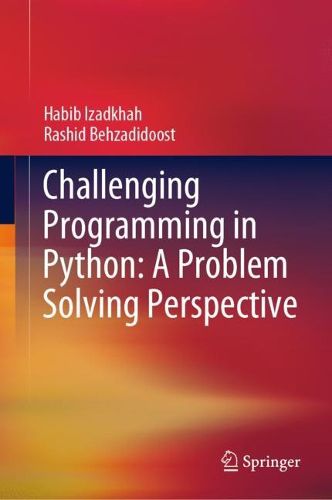
This book aims to strengthen programming skills and foster creative thinking by presenting and solving 90 challenging problems. The book is intended for individuals with elementary, intermediate, and advanced Python programming skills who aspire to take their abilities to the next level. Additionally, the book is valuable for individuals interested in enhancing their creative thinking and logical reasoning skills. It is a self-instructional book meant to provide readers with the ability to solve challenging problems independently. The presented challenges are lucidly and succinctly expressed, facilitating readers to follow along and comprehend the problem-solving process. The challenges cover various fields, making it suitable for a wide range of individuals.
The book is divided into eight chapters, beginning with an introduction in chapter one. The second chapter presents essential Python basics for programming challenging problems, while the subsequent chapters focuson specific types of challenges. These include math-based challenges in chapter three, number-based challenges in chapter four, string-based challenges in chapter five, game-based challenges in chapter six, count-based challenges in chapter seven, and miscellaneous challenges in chapter eight. Each chapter comprises a set of challenges with examples, hints, algorithms, and Python code solutions. The target audience of the book includes computer science and engineering students, teachers, software developers, and participants in programming competitions.
$9.00 standard shipping within Australia
FREE standard shipping within Australia for orders over $100.00
Express & International shipping calculated at checkout
Stock availability can be subject to change without notice. We recommend calling the shop or contacting our online team to check availability of low stock items. Please see our Shopping Online page for more details.
This title is printed to order. This book may have been self-published. If so, we cannot guarantee the quality of the content. In the main most books will have gone through the editing process however some may not. We therefore suggest that you be aware of this before ordering this book. If in doubt check either the author or publisher’s details as we are unable to accept any returns unless they are faulty. Please contact us if you have any questions.
This book aims to strengthen programming skills and foster creative thinking by presenting and solving 90 challenging problems. The book is intended for individuals with elementary, intermediate, and advanced Python programming skills who aspire to take their abilities to the next level. Additionally, the book is valuable for individuals interested in enhancing their creative thinking and logical reasoning skills. It is a self-instructional book meant to provide readers with the ability to solve challenging problems independently. The presented challenges are lucidly and succinctly expressed, facilitating readers to follow along and comprehend the problem-solving process. The challenges cover various fields, making it suitable for a wide range of individuals.
The book is divided into eight chapters, beginning with an introduction in chapter one. The second chapter presents essential Python basics for programming challenging problems, while the subsequent chapters focuson specific types of challenges. These include math-based challenges in chapter three, number-based challenges in chapter four, string-based challenges in chapter five, game-based challenges in chapter six, count-based challenges in chapter seven, and miscellaneous challenges in chapter eight. Each chapter comprises a set of challenges with examples, hints, algorithms, and Python code solutions. The target audience of the book includes computer science and engineering students, teachers, software developers, and participants in programming competitions.
Search our extensive online catalogue.
