Readings Newsletter
Become a Readings Member to make your shopping experience even easier.
Sign in or sign up for free!
You’re not far away from qualifying for FREE standard shipping within Australia
You’ve qualified for FREE standard shipping within Australia
The cart is loading…


This title is printed to order. This book may have been self-published. If so, we cannot guarantee the quality of the content. In the main most books will have gone through the editing process however some may not. We therefore suggest that you be aware of this before ordering this book. If in doubt check either the author or publisher’s details as we are unable to accept any returns unless they are faulty. Please contact us if you have any questions.
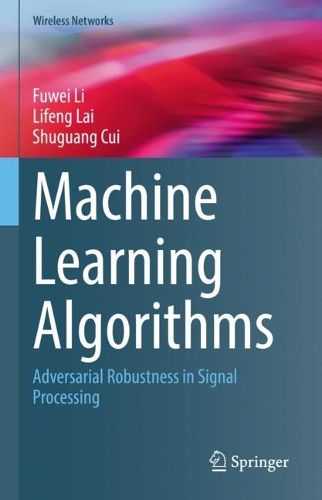
This book demonstrates the optimal adversarial attacks against several important signal processing algorithms. Through presenting the optimal attacks in wireless sensor networks, array signal processing, principal component analysis, etc, the authors reveal the robustness of the signal processing algorithms against adversarial attacks. Since data quality is crucial in signal processing, the adversary that can poison the data will be a significant threat to signal processing. Therefore, it is necessary and urgent to investigate the behavior of machine learning algorithms in signal processing under adversarial attacks.
The authors in this book mainly examine the adversarial robustness of three commonly used machine learning algorithms in signal processing respectively: linear regression, LASSO-based feature selection, and principal component analysis (PCA). As to linear regression, the authors derive the optimal poisoning data sample and the optimal feature modifications, and also demonstrate the effectiveness of the attack against a wireless distributed learning system. The authors further extend the linear regression to LASSO-based feature selection and study the best strategy to mislead the learning system to select the wrong features. The authors find the optimal attack strategy by solving a bi-level optimization problem and also illustrate how this attack influences array signal processing and weather data analysis. In the end, the authors consider the adversarial robustness of the subspace learning problem. The authors examine the optimal modification strategy under the energy constraints to delude the PCA-based subspace learning algorithm.
This book targets researchers working in machine learning, electronic information, and information theory as well as advanced-level students studying these subjects. R&D engineers who are working in machine learning, adversarial machine learning, robust machine learning, and technical consultants working on the security and robustness of machine learning are likely to purchase this book as a reference guide.
$9.00 standard shipping within Australia
FREE standard shipping within Australia for orders over $100.00
Express & International shipping calculated at checkout
Stock availability can be subject to change without notice. We recommend calling the shop or contacting our online team to check availability of low stock items. Please see our Shopping Online page for more details.
This title is printed to order. This book may have been self-published. If so, we cannot guarantee the quality of the content. In the main most books will have gone through the editing process however some may not. We therefore suggest that you be aware of this before ordering this book. If in doubt check either the author or publisher’s details as we are unable to accept any returns unless they are faulty. Please contact us if you have any questions.
This book demonstrates the optimal adversarial attacks against several important signal processing algorithms. Through presenting the optimal attacks in wireless sensor networks, array signal processing, principal component analysis, etc, the authors reveal the robustness of the signal processing algorithms against adversarial attacks. Since data quality is crucial in signal processing, the adversary that can poison the data will be a significant threat to signal processing. Therefore, it is necessary and urgent to investigate the behavior of machine learning algorithms in signal processing under adversarial attacks.
The authors in this book mainly examine the adversarial robustness of three commonly used machine learning algorithms in signal processing respectively: linear regression, LASSO-based feature selection, and principal component analysis (PCA). As to linear regression, the authors derive the optimal poisoning data sample and the optimal feature modifications, and also demonstrate the effectiveness of the attack against a wireless distributed learning system. The authors further extend the linear regression to LASSO-based feature selection and study the best strategy to mislead the learning system to select the wrong features. The authors find the optimal attack strategy by solving a bi-level optimization problem and also illustrate how this attack influences array signal processing and weather data analysis. In the end, the authors consider the adversarial robustness of the subspace learning problem. The authors examine the optimal modification strategy under the energy constraints to delude the PCA-based subspace learning algorithm.
This book targets researchers working in machine learning, electronic information, and information theory as well as advanced-level students studying these subjects. R&D engineers who are working in machine learning, adversarial machine learning, robust machine learning, and technical consultants working on the security and robustness of machine learning are likely to purchase this book as a reference guide.
Search our extensive online catalogue.
