Readings Newsletter
Become a Readings Member to make your shopping experience even easier.
Sign in or sign up for free!
You’re not far away from qualifying for FREE standard shipping within Australia
You’ve qualified for FREE standard shipping within Australia
The cart is loading…


This title is printed to order. This book may have been self-published. If so, we cannot guarantee the quality of the content. In the main most books will have gone through the editing process however some may not. We therefore suggest that you be aware of this before ordering this book. If in doubt check either the author or publisher’s details as we are unable to accept any returns unless they are faulty. Please contact us if you have any questions.
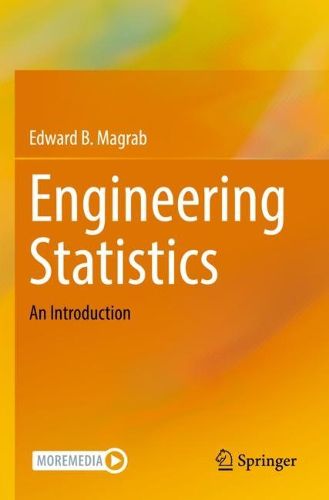
This book presents a concise and focused introduction to engineering statistics, emphasizing topics and concepts that a practicing engineer is mostly likely to use: the display of data, confidence intervals, hypothesis testing, fitting straight lines to data, and designing experiments to find the impact of process changes on a system or its output. It introduces the language of statistics, derives equations with sufficient detail so that there is no mystery as to how they came about, makes extensive use of tables to collect and summarize important formulas and concepts, and utilizes enhanced graphics that are packed with visual information to illustrate the meaning of the equations and their usage. The book can be used as an introduction to the subject, to refresh one's knowledge of engineering statistics, to complement course materials, as a study guide, and to provide a resource in laboratories where data acquisition and analysis are performed.
Created specifically forthe book are 16 interactive graphics (IGs) that can be used to replicate all numerical calculations appearing in the book and many of its figures, numerically evaluate all formulas appearing in tables, solve all exercises, and determine probabilities and critical values for commonly used probability distributions. After downloading a free program, the IGs are ready to use and are self-explanatory in the context of the material.
$9.00 standard shipping within Australia
FREE standard shipping within Australia for orders over $100.00
Express & International shipping calculated at checkout
Stock availability can be subject to change without notice. We recommend calling the shop or contacting our online team to check availability of low stock items. Please see our Shopping Online page for more details.
This title is printed to order. This book may have been self-published. If so, we cannot guarantee the quality of the content. In the main most books will have gone through the editing process however some may not. We therefore suggest that you be aware of this before ordering this book. If in doubt check either the author or publisher’s details as we are unable to accept any returns unless they are faulty. Please contact us if you have any questions.
This book presents a concise and focused introduction to engineering statistics, emphasizing topics and concepts that a practicing engineer is mostly likely to use: the display of data, confidence intervals, hypothesis testing, fitting straight lines to data, and designing experiments to find the impact of process changes on a system or its output. It introduces the language of statistics, derives equations with sufficient detail so that there is no mystery as to how they came about, makes extensive use of tables to collect and summarize important formulas and concepts, and utilizes enhanced graphics that are packed with visual information to illustrate the meaning of the equations and their usage. The book can be used as an introduction to the subject, to refresh one's knowledge of engineering statistics, to complement course materials, as a study guide, and to provide a resource in laboratories where data acquisition and analysis are performed.
Created specifically forthe book are 16 interactive graphics (IGs) that can be used to replicate all numerical calculations appearing in the book and many of its figures, numerically evaluate all formulas appearing in tables, solve all exercises, and determine probabilities and critical values for commonly used probability distributions. After downloading a free program, the IGs are ready to use and are self-explanatory in the context of the material.
Search our extensive online catalogue.
