Readings Newsletter
Become a Readings Member to make your shopping experience even easier.
Sign in or sign up for free!
You’re not far away from qualifying for FREE standard shipping within Australia
You’ve qualified for FREE standard shipping within Australia
The cart is loading…


This title is printed to order. This book may have been self-published. If so, we cannot guarantee the quality of the content. In the main most books will have gone through the editing process however some may not. We therefore suggest that you be aware of this before ordering this book. If in doubt check either the author or publisher’s details as we are unable to accept any returns unless they are faulty. Please contact us if you have any questions.
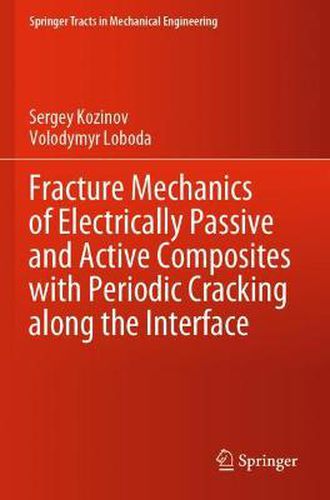
This book offers a comprehensive and timely review of the fracture behavior of bimaterial composites consisting of periodically connected components, i.e. of bimaterial composites possessing periodical cracks along the interface. It first presents an overview of the literature, and then analyzes the isotropic, anisotropic and piezoelectric/dielectric properties of bimaterial components, gradually increasing the difficulty of the solutions discussed up to the coupled electromechanical problems. While in the case of isotropic and anisotropic materials it covers the problems generated by an arbitrary set of cracks, for the piezoelectric materials it focuses on studying the influence of the electric permittivity of the crack’s filler, using not only a simple, fully electrically permeable model, but also a physically realistic, semi-permeable model. Throughout the analyses, the effects of the contact of the crack faces are taken into account so as to exclude the physically unrealistic interpenetration of the composite components that are typical of the classical open model. Further, the book derives and examines the mechanical and electromechanical fields, stress and electric intensity factors in detail. Providing extensive information on the fracture processes taking place in composite materials, the book helps readers become familiar with mathematical methods of complex function theory for obtaining exact analytical solutions.
$9.00 standard shipping within Australia
FREE standard shipping within Australia for orders over $100.00
Express & International shipping calculated at checkout
Stock availability can be subject to change without notice. We recommend calling the shop or contacting our online team to check availability of low stock items. Please see our Shopping Online page for more details.
This title is printed to order. This book may have been self-published. If so, we cannot guarantee the quality of the content. In the main most books will have gone through the editing process however some may not. We therefore suggest that you be aware of this before ordering this book. If in doubt check either the author or publisher’s details as we are unable to accept any returns unless they are faulty. Please contact us if you have any questions.
This book offers a comprehensive and timely review of the fracture behavior of bimaterial composites consisting of periodically connected components, i.e. of bimaterial composites possessing periodical cracks along the interface. It first presents an overview of the literature, and then analyzes the isotropic, anisotropic and piezoelectric/dielectric properties of bimaterial components, gradually increasing the difficulty of the solutions discussed up to the coupled electromechanical problems. While in the case of isotropic and anisotropic materials it covers the problems generated by an arbitrary set of cracks, for the piezoelectric materials it focuses on studying the influence of the electric permittivity of the crack’s filler, using not only a simple, fully electrically permeable model, but also a physically realistic, semi-permeable model. Throughout the analyses, the effects of the contact of the crack faces are taken into account so as to exclude the physically unrealistic interpenetration of the composite components that are typical of the classical open model. Further, the book derives and examines the mechanical and electromechanical fields, stress and electric intensity factors in detail. Providing extensive information on the fracture processes taking place in composite materials, the book helps readers become familiar with mathematical methods of complex function theory for obtaining exact analytical solutions.
Search our extensive online catalogue.
