Readings Newsletter
Become a Readings Member to make your shopping experience even easier.
Sign in or sign up for free!
You’re not far away from qualifying for FREE standard shipping within Australia
You’ve qualified for FREE standard shipping within Australia
The cart is loading…


This title is printed to order. This book may have been self-published. If so, we cannot guarantee the quality of the content. In the main most books will have gone through the editing process however some may not. We therefore suggest that you be aware of this before ordering this book. If in doubt check either the author or publisher’s details as we are unable to accept any returns unless they are faulty. Please contact us if you have any questions.
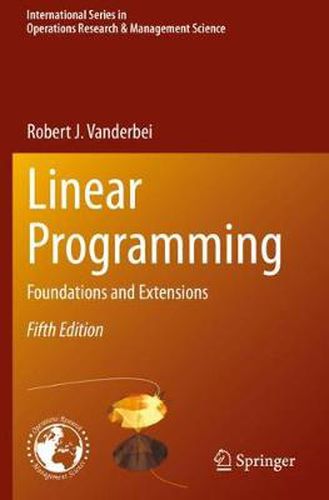
The book provides a broad introduction to both the theory and the application of optimization with a special emphasis on the elegance, importance, and usefulness of the parametric self-dual simplex method. The book assumes that a problem in standard form, is a problem with inequality constraints and nonnegative variables. The main new innovation to the book is the use of clickable links to the (newly updated) online app to help students do the trivial but tedious arithmetic when solving optimization problems.
The latest edition now includes: a discussion of modern Machine Learning applications, as motivational material; a section explaining Gomory Cuts and an application of integer programming to solve Sudoku problems. Readers will discover a host of practical business applications as well as non-business applications. Topics are clearly developed with many numerical examples worked out in detail. Specific examples and concrete algorithms precede more abstract topics.
With its focus on solving practical problems, the book features free C programs to implement the major algorithms covered, including the two-phase simplex method, the primal-dual simplex method, the path-following interior-point method, and and the homogeneous self-dual method. In addition, the author provides online tools that illustrate various pivot rules and variants of the simplex method, both for linear programming and for network flows. These C programs and online pivot tools can be found on the book’s website. The website also includes new online instructional tools and exercises.
$9.00 standard shipping within Australia
FREE standard shipping within Australia for orders over $100.00
Express & International shipping calculated at checkout
Stock availability can be subject to change without notice. We recommend calling the shop or contacting our online team to check availability of low stock items. Please see our Shopping Online page for more details.
This title is printed to order. This book may have been self-published. If so, we cannot guarantee the quality of the content. In the main most books will have gone through the editing process however some may not. We therefore suggest that you be aware of this before ordering this book. If in doubt check either the author or publisher’s details as we are unable to accept any returns unless they are faulty. Please contact us if you have any questions.
The book provides a broad introduction to both the theory and the application of optimization with a special emphasis on the elegance, importance, and usefulness of the parametric self-dual simplex method. The book assumes that a problem in standard form, is a problem with inequality constraints and nonnegative variables. The main new innovation to the book is the use of clickable links to the (newly updated) online app to help students do the trivial but tedious arithmetic when solving optimization problems.
The latest edition now includes: a discussion of modern Machine Learning applications, as motivational material; a section explaining Gomory Cuts and an application of integer programming to solve Sudoku problems. Readers will discover a host of practical business applications as well as non-business applications. Topics are clearly developed with many numerical examples worked out in detail. Specific examples and concrete algorithms precede more abstract topics.
With its focus on solving practical problems, the book features free C programs to implement the major algorithms covered, including the two-phase simplex method, the primal-dual simplex method, the path-following interior-point method, and and the homogeneous self-dual method. In addition, the author provides online tools that illustrate various pivot rules and variants of the simplex method, both for linear programming and for network flows. These C programs and online pivot tools can be found on the book’s website. The website also includes new online instructional tools and exercises.
Search our extensive online catalogue.
