Readings Newsletter
Become a Readings Member to make your shopping experience even easier.
Sign in or sign up for free!
You’re not far away from qualifying for FREE standard shipping within Australia
You’ve qualified for FREE standard shipping within Australia
The cart is loading…


This title is printed to order. This book may have been self-published. If so, we cannot guarantee the quality of the content. In the main most books will have gone through the editing process however some may not. We therefore suggest that you be aware of this before ordering this book. If in doubt check either the author or publisher’s details as we are unable to accept any returns unless they are faulty. Please contact us if you have any questions.
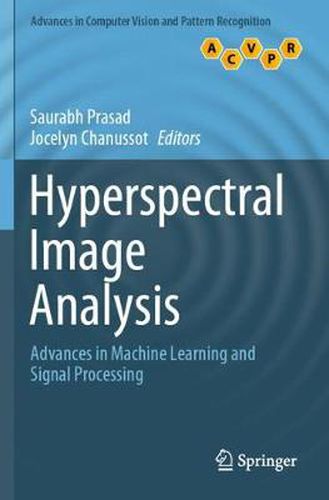
This book reviews the state of the art in algorithmic approaches addressing the practical challenges that arise with hyperspectral image analysis tasks, with a focus on emerging trends in machine learning and image processing/understanding. It presents advances in deep learning, multiple instance learning, sparse representation based learning, low-dimensional manifold models, anomalous change detection, target recognition, sensor fusion and super-resolution for robust multispectral and hyperspectral image understanding. It presents research from leading international experts who have made foundational contributions in these areas. The book covers a diverse array of applications of multispectral/hyperspectral imagery in the context of these algorithms, including remote sensing, face recognition and biomedicine. This book would be particularly beneficial to graduate students and researchers who are taking advanced courses in (or are working in) the areas of image analysis, machine learning and remote sensing with multi-channel optical imagery. Researchers and professionals in academia and industry working in areas such as electrical engineering, civil and environmental engineering, geosciences and biomedical image processing, who work with multi-channel optical data will find this book useful.
$9.00 standard shipping within Australia
FREE standard shipping within Australia for orders over $100.00
Express & International shipping calculated at checkout
Stock availability can be subject to change without notice. We recommend calling the shop or contacting our online team to check availability of low stock items. Please see our Shopping Online page for more details.
This title is printed to order. This book may have been self-published. If so, we cannot guarantee the quality of the content. In the main most books will have gone through the editing process however some may not. We therefore suggest that you be aware of this before ordering this book. If in doubt check either the author or publisher’s details as we are unable to accept any returns unless they are faulty. Please contact us if you have any questions.
This book reviews the state of the art in algorithmic approaches addressing the practical challenges that arise with hyperspectral image analysis tasks, with a focus on emerging trends in machine learning and image processing/understanding. It presents advances in deep learning, multiple instance learning, sparse representation based learning, low-dimensional manifold models, anomalous change detection, target recognition, sensor fusion and super-resolution for robust multispectral and hyperspectral image understanding. It presents research from leading international experts who have made foundational contributions in these areas. The book covers a diverse array of applications of multispectral/hyperspectral imagery in the context of these algorithms, including remote sensing, face recognition and biomedicine. This book would be particularly beneficial to graduate students and researchers who are taking advanced courses in (or are working in) the areas of image analysis, machine learning and remote sensing with multi-channel optical imagery. Researchers and professionals in academia and industry working in areas such as electrical engineering, civil and environmental engineering, geosciences and biomedical image processing, who work with multi-channel optical data will find this book useful.
Search our extensive online catalogue.
