Readings Newsletter
Become a Readings Member to make your shopping experience even easier.
Sign in or sign up for free!
You’re not far away from qualifying for FREE standard shipping within Australia
You’ve qualified for FREE standard shipping within Australia
The cart is loading…


This title is printed to order. This book may have been self-published. If so, we cannot guarantee the quality of the content. In the main most books will have gone through the editing process however some may not. We therefore suggest that you be aware of this before ordering this book. If in doubt check either the author or publisher’s details as we are unable to accept any returns unless they are faulty. Please contact us if you have any questions.
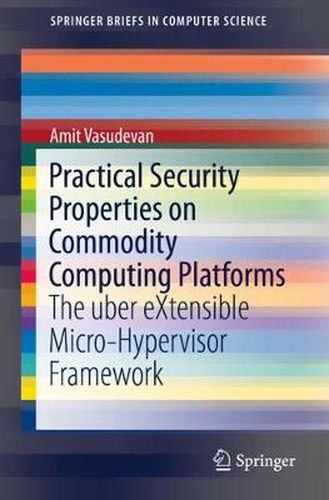
This SpringerBrief discusses the uber eXtensible Micro-hypervisor Framework (uberXMHF), a novel micro-hypervisor system security architecture and framework that can isolate security-sensitive applications from other untrustworthy applications on commodity platforms, enabling their safe co-existence. uberXMHF, in addition, facilitates runtime monitoring of the untrustworthy components, which is illustrated in this SpringerBrief. uberXMHF focuses on three goals which are keys to achieving practical security on commodity platforms: (a) commodity compatibility (e.g., runs unmodified Linux and Windows) and unfettered access to platform hardware; (b) low trusted computing base and complexity; and © efficient implementation. uberXMHF strives to be a comprehensible, practical and flexible platform for performing micro-hypervisor research and development. uberXMHF encapsulates common hypervisor core functionality in a framework that allows developers and users to build custom micro-hypervisor based (security-sensitive) applications (called uberapps ). The authors describe several uberapps that employ uberXMHF and showcase the framework efficacy and versatility. These uberapps span a wide spectrum of security applications including application compartmentalization and sandboxing, attestation, approved code execution, key management, tracing, verifiable resource accounting, trusted-path and on-demand I/O isolation. The authors are encouraged by the end result - a clean, barebones, low trusted computing base micro-hypervisor framework for commodity platforms with desirable performance characteristics and an architecture amenable to manual audits and/or formal reasoning. Active, open-source development of uberXMHF continues. The primary audience for this SpringerBrief is system (security) researchers and developers of commodity system software. Practitioners working in system security deployment mechanisms within industry and defense, as well as advanced-level students studying computer science with an interest in security will also want to read this SpringerBrief.
$9.00 standard shipping within Australia
FREE standard shipping within Australia for orders over $100.00
Express & International shipping calculated at checkout
Stock availability can be subject to change without notice. We recommend calling the shop or contacting our online team to check availability of low stock items. Please see our Shopping Online page for more details.
This title is printed to order. This book may have been self-published. If so, we cannot guarantee the quality of the content. In the main most books will have gone through the editing process however some may not. We therefore suggest that you be aware of this before ordering this book. If in doubt check either the author or publisher’s details as we are unable to accept any returns unless they are faulty. Please contact us if you have any questions.
This SpringerBrief discusses the uber eXtensible Micro-hypervisor Framework (uberXMHF), a novel micro-hypervisor system security architecture and framework that can isolate security-sensitive applications from other untrustworthy applications on commodity platforms, enabling their safe co-existence. uberXMHF, in addition, facilitates runtime monitoring of the untrustworthy components, which is illustrated in this SpringerBrief. uberXMHF focuses on three goals which are keys to achieving practical security on commodity platforms: (a) commodity compatibility (e.g., runs unmodified Linux and Windows) and unfettered access to platform hardware; (b) low trusted computing base and complexity; and © efficient implementation. uberXMHF strives to be a comprehensible, practical and flexible platform for performing micro-hypervisor research and development. uberXMHF encapsulates common hypervisor core functionality in a framework that allows developers and users to build custom micro-hypervisor based (security-sensitive) applications (called uberapps ). The authors describe several uberapps that employ uberXMHF and showcase the framework efficacy and versatility. These uberapps span a wide spectrum of security applications including application compartmentalization and sandboxing, attestation, approved code execution, key management, tracing, verifiable resource accounting, trusted-path and on-demand I/O isolation. The authors are encouraged by the end result - a clean, barebones, low trusted computing base micro-hypervisor framework for commodity platforms with desirable performance characteristics and an architecture amenable to manual audits and/or formal reasoning. Active, open-source development of uberXMHF continues. The primary audience for this SpringerBrief is system (security) researchers and developers of commodity system software. Practitioners working in system security deployment mechanisms within industry and defense, as well as advanced-level students studying computer science with an interest in security will also want to read this SpringerBrief.
Search our extensive online catalogue.
