Readings Newsletter
Become a Readings Member to make your shopping experience even easier.
Sign in or sign up for free!
You’re not far away from qualifying for FREE standard shipping within Australia
You’ve qualified for FREE standard shipping within Australia
The cart is loading…


This title is printed to order. This book may have been self-published. If so, we cannot guarantee the quality of the content. In the main most books will have gone through the editing process however some may not. We therefore suggest that you be aware of this before ordering this book. If in doubt check either the author or publisher’s details as we are unable to accept any returns unless they are faulty. Please contact us if you have any questions.
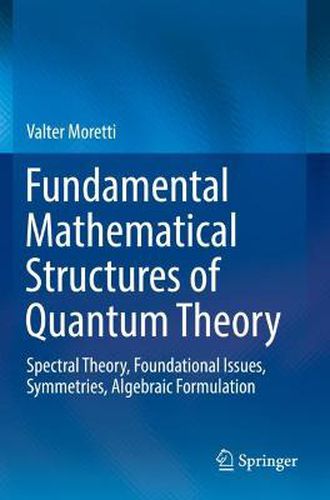
This textbook presents in a concise and self-contained way the advanced fundamental mathematical structures in quantum theory. It is based on lectures prepared for a 6 months course for MSc students. The reader is introduced to the beautiful interconnection between logic, lattice theory, general probability theory, and general spectral theory including the basic theory of von Neumann algebras and of the algebraic formulation, naturally arising in the study of the mathematical machinery of quantum theories. Some general results concerning hidden-variable interpretations of QM such as Gleason’s and the Kochen-Specker theorems and the related notions of realism and non-contextuality are carefully discussed. This is done also in relation with the famous Bell (BCHSH) inequality concerning local causality.
Written in a didactic style, this book includes many examples and solved exercises.
The work is organized as follows. Chapter 1 reviews some elementary facts and properties of quantum systems. Chapter 2 and 3 present the main results of spectral analysis in complex Hilbert spaces. Chapter 4 introduces the point of view of the orthomodular lattices’ theory. Quantum theory form this perspective turns out to the probability measure theory on the non-Boolean lattice of elementary observables and Gleason’s theorem characterizes all these measures. Chapter 5 deals with some philosophical and interpretative aspects of quantum theory like hidden-variable formulations of QM. The Kochen-Specker theorem and its implications are analyzed also in relation BCHSH inequality, entanglement, realism, locality, and non-contextuality. Chapter 6 focuses on the algebra of observables also in the presence of superselection rules introducing the notion of von Neumann algebra. Chapter 7 offers the idea of (groups of) quantum symmetry, in particular, illustrated in terms of Wigner and Kadison theorems. Chapter 8 deals with the elementary ideas and results of the so called algebraic formulation of quantum theories in terms of both *-algebras and C*-algebras.
This book should appeal to a dual readership: on one hand mathematicians that wish to acquire the tools that unlock the physical aspects of quantum theories; on the other physicists eager to solidify their understanding of the mathematical scaffolding of quantum theories.
$9.00 standard shipping within Australia
FREE standard shipping within Australia for orders over $100.00
Express & International shipping calculated at checkout
Stock availability can be subject to change without notice. We recommend calling the shop or contacting our online team to check availability of low stock items. Please see our Shopping Online page for more details.
This title is printed to order. This book may have been self-published. If so, we cannot guarantee the quality of the content. In the main most books will have gone through the editing process however some may not. We therefore suggest that you be aware of this before ordering this book. If in doubt check either the author or publisher’s details as we are unable to accept any returns unless they are faulty. Please contact us if you have any questions.
This textbook presents in a concise and self-contained way the advanced fundamental mathematical structures in quantum theory. It is based on lectures prepared for a 6 months course for MSc students. The reader is introduced to the beautiful interconnection between logic, lattice theory, general probability theory, and general spectral theory including the basic theory of von Neumann algebras and of the algebraic formulation, naturally arising in the study of the mathematical machinery of quantum theories. Some general results concerning hidden-variable interpretations of QM such as Gleason’s and the Kochen-Specker theorems and the related notions of realism and non-contextuality are carefully discussed. This is done also in relation with the famous Bell (BCHSH) inequality concerning local causality.
Written in a didactic style, this book includes many examples and solved exercises.
The work is organized as follows. Chapter 1 reviews some elementary facts and properties of quantum systems. Chapter 2 and 3 present the main results of spectral analysis in complex Hilbert spaces. Chapter 4 introduces the point of view of the orthomodular lattices’ theory. Quantum theory form this perspective turns out to the probability measure theory on the non-Boolean lattice of elementary observables and Gleason’s theorem characterizes all these measures. Chapter 5 deals with some philosophical and interpretative aspects of quantum theory like hidden-variable formulations of QM. The Kochen-Specker theorem and its implications are analyzed also in relation BCHSH inequality, entanglement, realism, locality, and non-contextuality. Chapter 6 focuses on the algebra of observables also in the presence of superselection rules introducing the notion of von Neumann algebra. Chapter 7 offers the idea of (groups of) quantum symmetry, in particular, illustrated in terms of Wigner and Kadison theorems. Chapter 8 deals with the elementary ideas and results of the so called algebraic formulation of quantum theories in terms of both *-algebras and C*-algebras.
This book should appeal to a dual readership: on one hand mathematicians that wish to acquire the tools that unlock the physical aspects of quantum theories; on the other physicists eager to solidify their understanding of the mathematical scaffolding of quantum theories.
Search our extensive online catalogue.
