Readings Newsletter
Become a Readings Member to make your shopping experience even easier.
Sign in or sign up for free!
You’re not far away from qualifying for FREE standard shipping within Australia
You’ve qualified for FREE standard shipping within Australia
The cart is loading…


This title is printed to order. This book may have been self-published. If so, we cannot guarantee the quality of the content. In the main most books will have gone through the editing process however some may not. We therefore suggest that you be aware of this before ordering this book. If in doubt check either the author or publisher’s details as we are unable to accept any returns unless they are faulty. Please contact us if you have any questions.
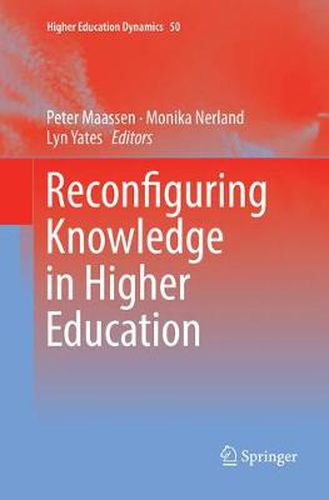
Knowledge is now central to national economic competitiveness and to socio-economic endeavours concerned with inequalities and social exclusion, and in this context higher education is recognized as a core sector of national policy and strategy. Yet the changing pressures, directions and practices in relation to knowledge pose many challenges for higher education itself. How can and how should research and study programs within higher education align with wider knowledge dynamics? How can higher education prepare students in professional fields for different kinds of knowledge-intensive work practices? How can short term economic objectives for higher education be aligned with other kinds of knowledge objectives that have characterized universities and colleges, and with the intensified impact of global rankings? This book takes as its focus the core interest of higher education in knowledge, and takes as its object of inquiry the kinds of reconfiguration of knowledge evident in national policies and governance; and in the redevelopment and practices of a range of professional and academic study programs in higher education institutions in Norway and Australia. From these detailed accounts, the book demonstrates the complexity of knowledge as an object of policy and practice; the competing logics that may be evident within and between study programs and policies; and the different kinds of agents and drivers that are part of knowledge reconfiguration in higher education and that need further attention going forward.
$9.00 standard shipping within Australia
FREE standard shipping within Australia for orders over $100.00
Express & International shipping calculated at checkout
Stock availability can be subject to change without notice. We recommend calling the shop or contacting our online team to check availability of low stock items. Please see our Shopping Online page for more details.
This title is printed to order. This book may have been self-published. If so, we cannot guarantee the quality of the content. In the main most books will have gone through the editing process however some may not. We therefore suggest that you be aware of this before ordering this book. If in doubt check either the author or publisher’s details as we are unable to accept any returns unless they are faulty. Please contact us if you have any questions.
Knowledge is now central to national economic competitiveness and to socio-economic endeavours concerned with inequalities and social exclusion, and in this context higher education is recognized as a core sector of national policy and strategy. Yet the changing pressures, directions and practices in relation to knowledge pose many challenges for higher education itself. How can and how should research and study programs within higher education align with wider knowledge dynamics? How can higher education prepare students in professional fields for different kinds of knowledge-intensive work practices? How can short term economic objectives for higher education be aligned with other kinds of knowledge objectives that have characterized universities and colleges, and with the intensified impact of global rankings? This book takes as its focus the core interest of higher education in knowledge, and takes as its object of inquiry the kinds of reconfiguration of knowledge evident in national policies and governance; and in the redevelopment and practices of a range of professional and academic study programs in higher education institutions in Norway and Australia. From these detailed accounts, the book demonstrates the complexity of knowledge as an object of policy and practice; the competing logics that may be evident within and between study programs and policies; and the different kinds of agents and drivers that are part of knowledge reconfiguration in higher education and that need further attention going forward.
Search our extensive online catalogue.
