Readings Newsletter
Become a Readings Member to make your shopping experience even easier.
Sign in or sign up for free!
You’re not far away from qualifying for FREE standard shipping within Australia
You’ve qualified for FREE standard shipping within Australia
The cart is loading…


This title is printed to order. This book may have been self-published. If so, we cannot guarantee the quality of the content. In the main most books will have gone through the editing process however some may not. We therefore suggest that you be aware of this before ordering this book. If in doubt check either the author or publisher’s details as we are unable to accept any returns unless they are faulty. Please contact us if you have any questions.
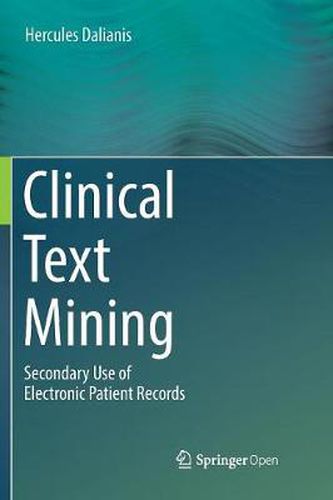
This open access book describes the results of natural language processing and machine learning methods applied to clinical text from electronic patient records.
It is divided into twelve chapters. Chapters 1-4 discuss the history and background of the original paper-based patient records, their purpose, and how they are written and structured. These initial chapters do not require any technical or medical background knowledge. The remaining eight chapters are more technical in nature and describe various medical classifications and terminologies such as ICD diagnosis codes, SNOMED CT, MeSH, UMLS, and ATC. Chapters 5-10 cover basic tools for natural language processing and information retrieval, and how to apply them to clinical text. The difference between rule-based and machine learning-based methods, as well as between supervised and unsupervised machine learning methods, are also explained. Next, ethical concerns regarding the use of sensitive patient records for research purposes are discussed, including methods for de-identifying electronic patient records and safely storing patient records. The book’s closing chapters present a number of applications in clinical text mining and summarise the lessons learned from the previous chapters.
The book provides a comprehensive overview of technical issues arising in clinical text mining, and offers a valuable guide for advanced students in health informatics, computational linguistics, and information retrieval, and for researchers entering these fields.
$9.00 standard shipping within Australia
FREE standard shipping within Australia for orders over $100.00
Express & International shipping calculated at checkout
Stock availability can be subject to change without notice. We recommend calling the shop or contacting our online team to check availability of low stock items. Please see our Shopping Online page for more details.
This title is printed to order. This book may have been self-published. If so, we cannot guarantee the quality of the content. In the main most books will have gone through the editing process however some may not. We therefore suggest that you be aware of this before ordering this book. If in doubt check either the author or publisher’s details as we are unable to accept any returns unless they are faulty. Please contact us if you have any questions.
This open access book describes the results of natural language processing and machine learning methods applied to clinical text from electronic patient records.
It is divided into twelve chapters. Chapters 1-4 discuss the history and background of the original paper-based patient records, their purpose, and how they are written and structured. These initial chapters do not require any technical or medical background knowledge. The remaining eight chapters are more technical in nature and describe various medical classifications and terminologies such as ICD diagnosis codes, SNOMED CT, MeSH, UMLS, and ATC. Chapters 5-10 cover basic tools for natural language processing and information retrieval, and how to apply them to clinical text. The difference between rule-based and machine learning-based methods, as well as between supervised and unsupervised machine learning methods, are also explained. Next, ethical concerns regarding the use of sensitive patient records for research purposes are discussed, including methods for de-identifying electronic patient records and safely storing patient records. The book’s closing chapters present a number of applications in clinical text mining and summarise the lessons learned from the previous chapters.
The book provides a comprehensive overview of technical issues arising in clinical text mining, and offers a valuable guide for advanced students in health informatics, computational linguistics, and information retrieval, and for researchers entering these fields.
Search our extensive online catalogue.
