Readings Newsletter
Become a Readings Member to make your shopping experience even easier.
Sign in or sign up for free!
You’re not far away from qualifying for FREE standard shipping within Australia
You’ve qualified for FREE standard shipping within Australia
The cart is loading…


This title is printed to order. This book may have been self-published. If so, we cannot guarantee the quality of the content. In the main most books will have gone through the editing process however some may not. We therefore suggest that you be aware of this before ordering this book. If in doubt check either the author or publisher’s details as we are unable to accept any returns unless they are faulty. Please contact us if you have any questions.
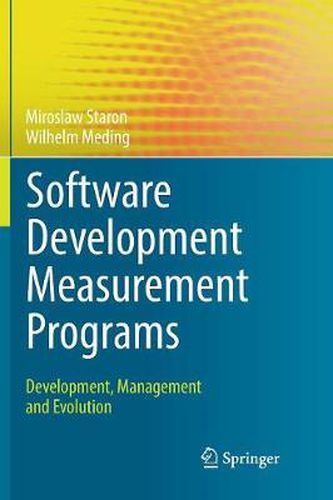
This book seeks to promote the structured, standardized and accurate use of software measurement at all levels of modern software development companies. To do so, it focuses on seven main aspects: sound scientific foundations, cost-efficiency, standardization, value-maximization, flexibility, combining organizational and technical aspects, and seamless technology integration. Further, it supports companies in their journey from manual reporting to automated decision support by combining academic research and industrial practice. When scientists and engineers measure something, they tend to focus on two different things. Scientists focus on the ability of the measurement to quantify whatever is being measured; engineers, however, focus on finding the right qualities of measurement given the designed system (e.g. correctness), the system’s quality of use (e.g. ease of use), and the efficiency of the measurement process. In this book, the authors argue that both focuses are necessary, and that the two are complementary. Thus, the book is organized as a gradual progression from theories of measurement (yes, you need theories to be successful!) to practical, organizational aspects of maintaining measurement systems (yes, you need the practical side to understand how to be successful). The authors of this book come from academia and industry, where they worked together for the past twelve years. They have worked with both small and large software development organizations, as researchers and as measurement engineers, measurement program leaders and even teachers. They wrote this book to help readers define, implement, deploy and maintain company-wide measurement programs, which consist of a set of measures, indicators and roles that are built around the concept of measurement systems. Based on their experiences introducing over 40,000 measurement systems at over a dozen companies, they share essential tips and tricks on how to do it right and how to avoid common pitfalls.
$9.00 standard shipping within Australia
FREE standard shipping within Australia for orders over $100.00
Express & International shipping calculated at checkout
Stock availability can be subject to change without notice. We recommend calling the shop or contacting our online team to check availability of low stock items. Please see our Shopping Online page for more details.
This title is printed to order. This book may have been self-published. If so, we cannot guarantee the quality of the content. In the main most books will have gone through the editing process however some may not. We therefore suggest that you be aware of this before ordering this book. If in doubt check either the author or publisher’s details as we are unable to accept any returns unless they are faulty. Please contact us if you have any questions.
This book seeks to promote the structured, standardized and accurate use of software measurement at all levels of modern software development companies. To do so, it focuses on seven main aspects: sound scientific foundations, cost-efficiency, standardization, value-maximization, flexibility, combining organizational and technical aspects, and seamless technology integration. Further, it supports companies in their journey from manual reporting to automated decision support by combining academic research and industrial practice. When scientists and engineers measure something, they tend to focus on two different things. Scientists focus on the ability of the measurement to quantify whatever is being measured; engineers, however, focus on finding the right qualities of measurement given the designed system (e.g. correctness), the system’s quality of use (e.g. ease of use), and the efficiency of the measurement process. In this book, the authors argue that both focuses are necessary, and that the two are complementary. Thus, the book is organized as a gradual progression from theories of measurement (yes, you need theories to be successful!) to practical, organizational aspects of maintaining measurement systems (yes, you need the practical side to understand how to be successful). The authors of this book come from academia and industry, where they worked together for the past twelve years. They have worked with both small and large software development organizations, as researchers and as measurement engineers, measurement program leaders and even teachers. They wrote this book to help readers define, implement, deploy and maintain company-wide measurement programs, which consist of a set of measures, indicators and roles that are built around the concept of measurement systems. Based on their experiences introducing over 40,000 measurement systems at over a dozen companies, they share essential tips and tricks on how to do it right and how to avoid common pitfalls.
Search our extensive online catalogue.
