Readings Newsletter
Become a Readings Member to make your shopping experience even easier.
Sign in or sign up for free!
You’re not far away from qualifying for FREE standard shipping within Australia
You’ve qualified for FREE standard shipping within Australia
The cart is loading…


This title is printed to order. This book may have been self-published. If so, we cannot guarantee the quality of the content. In the main most books will have gone through the editing process however some may not. We therefore suggest that you be aware of this before ordering this book. If in doubt check either the author or publisher’s details as we are unable to accept any returns unless they are faulty. Please contact us if you have any questions.
I was a musician before I was anything else. That's how I first used technology-not through code or commerce, but through sound. In the late 1980s, I stood in an "electronic music studio" at Bennington College in Vermont, staring at a new keyboard called The Synclavier. I didn't know how it worked, but I could feel what sounds it wanted to make. It wasn't just a machine-it was a co-conspirator. It could emulate, sample, sequence, and distort. I could pull emotion out of circuitry. At the time, it felt like the future. Not the kind with flying cars, but the kind where machines could jam with you, if you knew how to ask. What struck me then still rings true now: the best machines don't replace creativity. They provoke it.
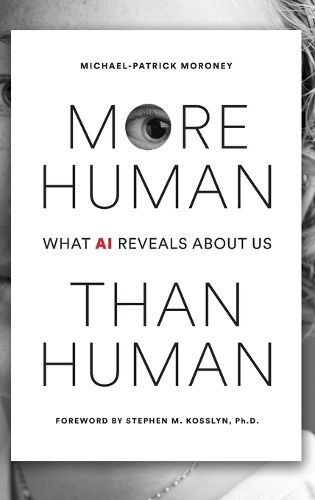
Foreword by Stephen M. Kosslyn, Ph.D. Cognitive Neuroscientist, Dean of Social Science, Harvard University
We are living in a time when the boundary between mind and machine is no longer theoretical-it is experiential. Every day, millions of people interact with systems that predict, persuade, and create. Yet, as artificial intelligence (AI) becomes more powerful, the most urgent question may not be what machines can do, but what they reveal about us in the process.
$9.00 standard shipping within Australia
FREE standard shipping within Australia for orders over $100.00
Express & International shipping calculated at checkout
Stock availability can be subject to change without notice. We recommend calling the shop or contacting our online team to check availability of low stock items. Please see our Shopping Online page for more details.
This title is printed to order. This book may have been self-published. If so, we cannot guarantee the quality of the content. In the main most books will have gone through the editing process however some may not. We therefore suggest that you be aware of this before ordering this book. If in doubt check either the author or publisher’s details as we are unable to accept any returns unless they are faulty. Please contact us if you have any questions.
I was a musician before I was anything else. That's how I first used technology-not through code or commerce, but through sound. In the late 1980s, I stood in an "electronic music studio" at Bennington College in Vermont, staring at a new keyboard called The Synclavier. I didn't know how it worked, but I could feel what sounds it wanted to make. It wasn't just a machine-it was a co-conspirator. It could emulate, sample, sequence, and distort. I could pull emotion out of circuitry. At the time, it felt like the future. Not the kind with flying cars, but the kind where machines could jam with you, if you knew how to ask. What struck me then still rings true now: the best machines don't replace creativity. They provoke it.
Foreword by Stephen M. Kosslyn, Ph.D. Cognitive Neuroscientist, Dean of Social Science, Harvard University
We are living in a time when the boundary between mind and machine is no longer theoretical-it is experiential. Every day, millions of people interact with systems that predict, persuade, and create. Yet, as artificial intelligence (AI) becomes more powerful, the most urgent question may not be what machines can do, but what they reveal about us in the process.
Search our extensive online catalogue.
