Readings Newsletter
Become a Readings Member to make your shopping experience even easier.
Sign in or sign up for free!
You’re not far away from qualifying for FREE standard shipping within Australia
You’ve qualified for FREE standard shipping within Australia
The cart is loading…


This title is printed to order. This book may have been self-published. If so, we cannot guarantee the quality of the content. In the main most books will have gone through the editing process however some may not. We therefore suggest that you be aware of this before ordering this book. If in doubt check either the author or publisher’s details as we are unable to accept any returns unless they are faulty. Please contact us if you have any questions.
"Painting is also expressing, through signs, that which one cannot-or does not know how to-express with actions. This could be one reason for continuing, even if the storehouses of the world are already full of things to look at. Faced with the new matters of art, people pull the wool over their eyes, fearing that their world, made of comfortable and uplifting ideas about beauty, might fall to pieces. This is another reason to continue, because in this way, one reaches an initial result-an initial function, if you will-of art as 'revolutionary' research." (p. 315)
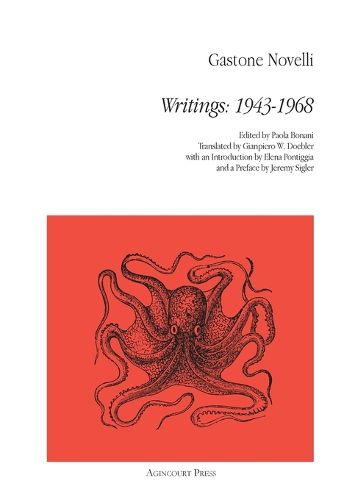
Gastone Novelli (1925-1968) was an Italian painter active in the 1950s and 60s, producing innovative, non-figurative modern artworks now found in the collections of the British Museum in London, MoMA in New York, the National Gallery of Art in Washington DC, the Galleria Nazionale d'Arte Moderna in Rome, and other prominent museums in Milan, Venice, Torino, Sao Paolo, and elsewhere. Novelli's works reflect his intense interest in language-not as narrative or tradition but as original expression and visual possibility. In addition to his artworks, Novelli left a rich trove of writings in varied tones and styles: vivid, first-hand accounts of life in a Roman prison during and after German occupation in World War II; polemical discussion of the art of his time and of the preceding decades; poetry; course outlines on visual composition and perception; insightful yet dreamlike travelogues; and correspondence. All of these are presented here.
$9.00 standard shipping within Australia
FREE standard shipping within Australia for orders over $100.00
Express & International shipping calculated at checkout
Stock availability can be subject to change without notice. We recommend calling the shop or contacting our online team to check availability of low stock items. Please see our Shopping Online page for more details.
This title is printed to order. This book may have been self-published. If so, we cannot guarantee the quality of the content. In the main most books will have gone through the editing process however some may not. We therefore suggest that you be aware of this before ordering this book. If in doubt check either the author or publisher’s details as we are unable to accept any returns unless they are faulty. Please contact us if you have any questions.
"Painting is also expressing, through signs, that which one cannot-or does not know how to-express with actions. This could be one reason for continuing, even if the storehouses of the world are already full of things to look at. Faced with the new matters of art, people pull the wool over their eyes, fearing that their world, made of comfortable and uplifting ideas about beauty, might fall to pieces. This is another reason to continue, because in this way, one reaches an initial result-an initial function, if you will-of art as 'revolutionary' research." (p. 315)
Gastone Novelli (1925-1968) was an Italian painter active in the 1950s and 60s, producing innovative, non-figurative modern artworks now found in the collections of the British Museum in London, MoMA in New York, the National Gallery of Art in Washington DC, the Galleria Nazionale d'Arte Moderna in Rome, and other prominent museums in Milan, Venice, Torino, Sao Paolo, and elsewhere. Novelli's works reflect his intense interest in language-not as narrative or tradition but as original expression and visual possibility. In addition to his artworks, Novelli left a rich trove of writings in varied tones and styles: vivid, first-hand accounts of life in a Roman prison during and after German occupation in World War II; polemical discussion of the art of his time and of the preceding decades; poetry; course outlines on visual composition and perception; insightful yet dreamlike travelogues; and correspondence. All of these are presented here.
Search our extensive online catalogue.
