Readings Newsletter
Become a Readings Member to make your shopping experience even easier.
Sign in or sign up for free!
You’re not far away from qualifying for FREE standard shipping within Australia
You’ve qualified for FREE standard shipping within Australia
The cart is loading…


This title is printed to order. This book may have been self-published. If so, we cannot guarantee the quality of the content. In the main most books will have gone through the editing process however some may not. We therefore suggest that you be aware of this before ordering this book. If in doubt check either the author or publisher’s details as we are unable to accept any returns unless they are faulty. Please contact us if you have any questions.
The result of eighteen years of design and research, the A7L and A7LB spacesuits served during the Apollo, Skylab and Apollo-Soyuz missions. Designed by International Latex Corporation (ILC) Dover and with a life support backpack provided by Hamilton Standard, the A7L featured a water-cooled undergarment, an inner blue pressurized layer, and a tough white nylon outer hull. After the disastrous Apollo I fire, ILC produced a version that utilized beta cloth that is fire resistant up to 650 degrees Celsius. Two basic versions of the suit were used during Apollo: an EV A7L configuration for the command module pilot (CMP) that provided low pressure and fire protection as well as protection for free-space EVA, and the EV A7L PGA configuration that provided additional protection from the lunar surface environment. Apollo 7-14 used the A7L design that provided six hours of primary and thirty minutes of emergency life support. The longer
J
missions 15, 16 and 17 utilized the A7LB suit that extended primary life support by an hour, and also featured additional joints to facilitate operation of the lunar roving vehicle. CMPs on these missions wore A7LB based H-series A7L suits, as they needed to perform EVAs to retrieve film from the Scientific Instrument Module in
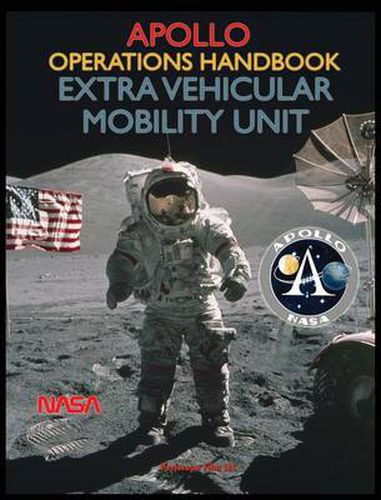
deep space . Modified A7LBs were also used during both Skylab and Apollo-Soyuz. Created by NASA in 1968 and revised in 1971 for the Apollo 15, 16 and 17 missions, this handbook explains the extravehicular mobility unit, its subsystems, accessories and operation, as well as emergency procedures. Originally printed in two volumes by NASA, this version incorporates both in one book.
$9.00 standard shipping within Australia
FREE standard shipping within Australia for orders over $100.00
Express & International shipping calculated at checkout
Stock availability can be subject to change without notice. We recommend calling the shop or contacting our online team to check availability of low stock items. Please see our Shopping Online page for more details.
This title is printed to order. This book may have been self-published. If so, we cannot guarantee the quality of the content. In the main most books will have gone through the editing process however some may not. We therefore suggest that you be aware of this before ordering this book. If in doubt check either the author or publisher’s details as we are unable to accept any returns unless they are faulty. Please contact us if you have any questions.
The result of eighteen years of design and research, the A7L and A7LB spacesuits served during the Apollo, Skylab and Apollo-Soyuz missions. Designed by International Latex Corporation (ILC) Dover and with a life support backpack provided by Hamilton Standard, the A7L featured a water-cooled undergarment, an inner blue pressurized layer, and a tough white nylon outer hull. After the disastrous Apollo I fire, ILC produced a version that utilized beta cloth that is fire resistant up to 650 degrees Celsius. Two basic versions of the suit were used during Apollo: an EV A7L configuration for the command module pilot (CMP) that provided low pressure and fire protection as well as protection for free-space EVA, and the EV A7L PGA configuration that provided additional protection from the lunar surface environment. Apollo 7-14 used the A7L design that provided six hours of primary and thirty minutes of emergency life support. The longer
J
missions 15, 16 and 17 utilized the A7LB suit that extended primary life support by an hour, and also featured additional joints to facilitate operation of the lunar roving vehicle. CMPs on these missions wore A7LB based H-series A7L suits, as they needed to perform EVAs to retrieve film from the Scientific Instrument Module in
deep space . Modified A7LBs were also used during both Skylab and Apollo-Soyuz. Created by NASA in 1968 and revised in 1971 for the Apollo 15, 16 and 17 missions, this handbook explains the extravehicular mobility unit, its subsystems, accessories and operation, as well as emergency procedures. Originally printed in two volumes by NASA, this version incorporates both in one book.
Search our extensive online catalogue.
