Readings Newsletter
Become a Readings Member to make your shopping experience even easier.
Sign in or sign up for free!
You’re not far away from qualifying for FREE standard shipping within Australia
You’ve qualified for FREE standard shipping within Australia
The cart is loading…


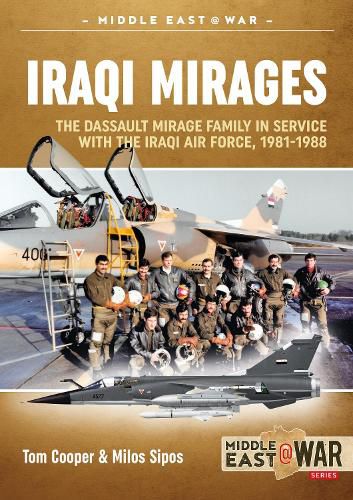
Originally envisaged as a privately funded project for a possible future NATO-fighter, the Dassault Mirage F.1 evolved into one of the most aesthetically attractive and commercially most successful combat aircraft of the 1970s and 1980s. Developed into more than a dozen of different variants and sub-variants
each of them custom-tailored to requirements of air forces that flew it
it also became a type that saw intensive combat service in numerous wars on no less than three different continents. Iraq became the biggest export customer for Mirage F.1. One way or the other, the Iraqi Air Force significantly contributed
and financed
the further development of this type, but also influenced research and development of a number of further systems that followed in its wake
most of which eventually found their way into operational service in France. While the Mirage F.1 has attracted at least some coverage in English language publications, its acquisition and combat deployment by Iraq still remains a topic with not a few controversies. The purpose of this volume is to redress the balance and provide an in-depth insight into the acquisition process, development and equipment of custom-tailored variants made for Iraq, training of Iraqi personnel on the type, and its combat deployment during wars against Iran, 1980-1988, and against the US-led, so-called Gulf Coalition, in 1991 and afterwards. Originally envisaged and acquired as a ‘pure’ interceptor, before long the Mirage F.1 in Iraqi service proved a highly capable multi-role platform aircraft, and was widely deployed not only for ground attack but also anti-shipping purposes, as an aerial tanker, and for delivering long-range pin-point attacks. Illustrated with over 120 photographs and many colour profiles, this book provides a unique, single point of reference on camouflage, markings, and armament configurations of Mirage F.1s in Iraqi service.
$9.00 standard shipping within Australia
FREE standard shipping within Australia for orders over $100.00
Express & International shipping calculated at checkout
Stock availability can be subject to change without notice. We recommend calling the shop or contacting our online team to check availability of low stock items. Please see our Shopping Online page for more details.
Originally envisaged as a privately funded project for a possible future NATO-fighter, the Dassault Mirage F.1 evolved into one of the most aesthetically attractive and commercially most successful combat aircraft of the 1970s and 1980s. Developed into more than a dozen of different variants and sub-variants
each of them custom-tailored to requirements of air forces that flew it
it also became a type that saw intensive combat service in numerous wars on no less than three different continents. Iraq became the biggest export customer for Mirage F.1. One way or the other, the Iraqi Air Force significantly contributed
and financed
the further development of this type, but also influenced research and development of a number of further systems that followed in its wake
most of which eventually found their way into operational service in France. While the Mirage F.1 has attracted at least some coverage in English language publications, its acquisition and combat deployment by Iraq still remains a topic with not a few controversies. The purpose of this volume is to redress the balance and provide an in-depth insight into the acquisition process, development and equipment of custom-tailored variants made for Iraq, training of Iraqi personnel on the type, and its combat deployment during wars against Iran, 1980-1988, and against the US-led, so-called Gulf Coalition, in 1991 and afterwards. Originally envisaged and acquired as a ‘pure’ interceptor, before long the Mirage F.1 in Iraqi service proved a highly capable multi-role platform aircraft, and was widely deployed not only for ground attack but also anti-shipping purposes, as an aerial tanker, and for delivering long-range pin-point attacks. Illustrated with over 120 photographs and many colour profiles, this book provides a unique, single point of reference on camouflage, markings, and armament configurations of Mirage F.1s in Iraqi service.
Search our extensive online catalogue.
