Readings Newsletter
Become a Readings Member to make your shopping experience even easier.
Sign in or sign up for free!
You’re not far away from qualifying for FREE standard shipping within Australia
You’ve qualified for FREE standard shipping within Australia
The cart is loading…


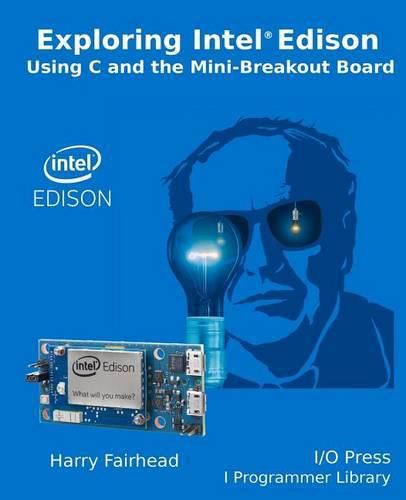
The Intel® Edison is a remarkable device. It is as small as an embedded processor, but has enough power to allow it to be used as a tiny server. With its built-in support for WiFi, GPIO, I2C and SPI it is a capable IoT device. However, to make use of its unique qualities you have to take a step beyond its simple Arduino emulation and make use of it as itself, in its native mode. This means using the mini-breakout board and dealing with the fact that it is a 1.8V logic device and programming it using C to bring out its full power. Once you know how, this isn’t as difficult as it seems at first. The rewards are well worth the effort. Exploring Intel® Edison starts with setting it up for the mini-breakout board. Then it looks at the advantages of choosing C as the language in which to program it, showing how to set up the Intel® System Studio IoT Edition IDE. Now we are ready to get building circuits and coding. Using the mraa library is the direct way to work with the GPIO lines and we need to master it before looking at ways of making things faster with memory-mapped I/O, achieving realtime facilities with Linux and using pulse width modulation. From here we are able to start connecting sensors - the HTU21D (I2C), DHT11/22 (custom) and the DS18B20 (1-wire). There are problems to overcome along the way - how to convert from 1.8V to work with higher voltages and how to support a 1-wire bus. The final circuit, to add AtoD, uses the SPI bus and implements a software emulation. Finally we look beyond mraa with a Linux-based approach to working with GPIO lines and how to set the GPIO mode.
$9.00 standard shipping within Australia
FREE standard shipping within Australia for orders over $100.00
Express & International shipping calculated at checkout
Stock availability can be subject to change without notice. We recommend calling the shop or contacting our online team to check availability of low stock items. Please see our Shopping Online page for more details.
The Intel® Edison is a remarkable device. It is as small as an embedded processor, but has enough power to allow it to be used as a tiny server. With its built-in support for WiFi, GPIO, I2C and SPI it is a capable IoT device. However, to make use of its unique qualities you have to take a step beyond its simple Arduino emulation and make use of it as itself, in its native mode. This means using the mini-breakout board and dealing with the fact that it is a 1.8V logic device and programming it using C to bring out its full power. Once you know how, this isn’t as difficult as it seems at first. The rewards are well worth the effort. Exploring Intel® Edison starts with setting it up for the mini-breakout board. Then it looks at the advantages of choosing C as the language in which to program it, showing how to set up the Intel® System Studio IoT Edition IDE. Now we are ready to get building circuits and coding. Using the mraa library is the direct way to work with the GPIO lines and we need to master it before looking at ways of making things faster with memory-mapped I/O, achieving realtime facilities with Linux and using pulse width modulation. From here we are able to start connecting sensors - the HTU21D (I2C), DHT11/22 (custom) and the DS18B20 (1-wire). There are problems to overcome along the way - how to convert from 1.8V to work with higher voltages and how to support a 1-wire bus. The final circuit, to add AtoD, uses the SPI bus and implements a software emulation. Finally we look beyond mraa with a Linux-based approach to working with GPIO lines and how to set the GPIO mode.
Search our extensive online catalogue.
