Readings Newsletter
Become a Readings Member to make your shopping experience even easier.
Sign in or sign up for free!
You’re not far away from qualifying for FREE standard shipping within Australia
You’ve qualified for FREE standard shipping within Australia
The cart is loading…


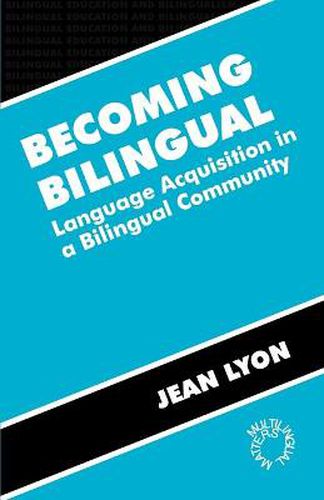
Language is one of humanity’s greatest achievements, yet one which virtually all children achieve remarkably quickly. How much more remarkable, therefore, when children learn not one but two languages! There are many single case studies describing children from families where determined parents adopt strategies to maximise their children’s chances of becoming bilingual. Many more children, whose parents speak a mixture of languages, also become bilingual without this extra help. How this occurs and why some children have more problems than others in a bilingual environment are some of the issues addressed by this book, which is a longitudinal study of how children learn to use more than one language. The family is assumed to be the key factor in these processes, and bilingual language development is placed firmly within an interactive context, as it is from this context that the development of childhood bilingualism can best be understood. Thus the aims of this book are to examine how young children become bilingual, and to show what factors predict early childhood bilingualism.
$9.00 standard shipping within Australia
FREE standard shipping within Australia for orders over $100.00
Express & International shipping calculated at checkout
Stock availability can be subject to change without notice. We recommend calling the shop or contacting our online team to check availability of low stock items. Please see our Shopping Online page for more details.
Language is one of humanity’s greatest achievements, yet one which virtually all children achieve remarkably quickly. How much more remarkable, therefore, when children learn not one but two languages! There are many single case studies describing children from families where determined parents adopt strategies to maximise their children’s chances of becoming bilingual. Many more children, whose parents speak a mixture of languages, also become bilingual without this extra help. How this occurs and why some children have more problems than others in a bilingual environment are some of the issues addressed by this book, which is a longitudinal study of how children learn to use more than one language. The family is assumed to be the key factor in these processes, and bilingual language development is placed firmly within an interactive context, as it is from this context that the development of childhood bilingualism can best be understood. Thus the aims of this book are to examine how young children become bilingual, and to show what factors predict early childhood bilingualism.
Search our extensive online catalogue.
