Readings Newsletter
Become a Readings Member to make your shopping experience even easier.
Sign in or sign up for free!
You’re not far away from qualifying for FREE standard shipping within Australia
You’ve qualified for FREE standard shipping within Australia
The cart is loading…


This title is printed to order. This book may have been self-published. If so, we cannot guarantee the quality of the content. In the main most books will have gone through the editing process however some may not. We therefore suggest that you be aware of this before ordering this book. If in doubt check either the author or publisher’s details as we are unable to accept any returns unless they are faulty. Please contact us if you have any questions.
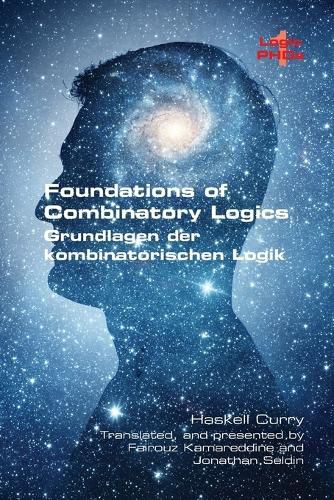
Curry’s PhD dissertation Introduction to Combinatory Logic, represents a first major work on a new subject. Curry’s interest in the subject started when he noticed the complicated form of substitution in Principia Mathematica and set about trying to find a simpler form of this rule. This led him by 1926 to some of the combinators. In 1928 Curry went to G\ ottingen and completed his dissertation in 1929 under the direction of David Hilbert. This book is a translation of the dissertation.
Curry’s dissertation was the first publication to give a complete formal development of combinatory logic as a formal system in which the terms are built up from variables and a number of constants (combinators including B, C and K) by means of application. The proof of the consistency of the system faced the major difficulty that the only reduction relation Curry had was what we now call weak reduction. This made it impossible to prove the Church-Rosser Theorem, which is now the standard way one proves the consistency of systems of this kind. Instead, Curry was looking at sequences based on what we now call weak contractions with strings of variables added on the right.
After his dissertation, Curry developed further ground-breaking ideas that continue to be very influential. These include, functionality (which became the basis of what we now call type assignment), the correspondence between types and implication formulas (the beginning of the idea of propositions as types ) and generalised functionality (a form of dependent types in modern type systems). Curry’s ideas continue to influence developments in mathematics, logic and computation.
We hope that making his original thesis available in English will help make his ideas clearer.
We have made use of all information we could find by Curry, mostly from marginal notes in his copy of the dissertation, indicating corrections to the original German.
$9.00 standard shipping within Australia
FREE standard shipping within Australia for orders over $100.00
Express & International shipping calculated at checkout
Stock availability can be subject to change without notice. We recommend calling the shop or contacting our online team to check availability of low stock items. Please see our Shopping Online page for more details.
This title is printed to order. This book may have been self-published. If so, we cannot guarantee the quality of the content. In the main most books will have gone through the editing process however some may not. We therefore suggest that you be aware of this before ordering this book. If in doubt check either the author or publisher’s details as we are unable to accept any returns unless they are faulty. Please contact us if you have any questions.
Curry’s PhD dissertation Introduction to Combinatory Logic, represents a first major work on a new subject. Curry’s interest in the subject started when he noticed the complicated form of substitution in Principia Mathematica and set about trying to find a simpler form of this rule. This led him by 1926 to some of the combinators. In 1928 Curry went to G\ ottingen and completed his dissertation in 1929 under the direction of David Hilbert. This book is a translation of the dissertation.
Curry’s dissertation was the first publication to give a complete formal development of combinatory logic as a formal system in which the terms are built up from variables and a number of constants (combinators including B, C and K) by means of application. The proof of the consistency of the system faced the major difficulty that the only reduction relation Curry had was what we now call weak reduction. This made it impossible to prove the Church-Rosser Theorem, which is now the standard way one proves the consistency of systems of this kind. Instead, Curry was looking at sequences based on what we now call weak contractions with strings of variables added on the right.
After his dissertation, Curry developed further ground-breaking ideas that continue to be very influential. These include, functionality (which became the basis of what we now call type assignment), the correspondence between types and implication formulas (the beginning of the idea of propositions as types ) and generalised functionality (a form of dependent types in modern type systems). Curry’s ideas continue to influence developments in mathematics, logic and computation.
We hope that making his original thesis available in English will help make his ideas clearer.
We have made use of all information we could find by Curry, mostly from marginal notes in his copy of the dissertation, indicating corrections to the original German.
Search our extensive online catalogue.
