Readings Newsletter
Become a Readings Member to make your shopping experience even easier.
Sign in or sign up for free!
You’re not far away from qualifying for FREE standard shipping within Australia
You’ve qualified for FREE standard shipping within Australia
The cart is loading…


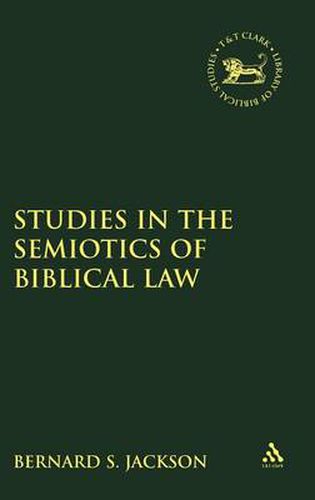
This book explains and illustrates a variety of semiotic issues in the study of biblical law. Commencing with a review of relevant literature in linguistics, philosophy, semiotics and psychology, it examines biblical law in terms of its users, its medium and its message. It criticizes our use of the notion of ‘literal meaning’, at the level of both words and sentences, preferring to see meaning constructed by the narrative images that the language evokes. These images may come from either social experience or cultural narratives. Speech performance is important, both in the negotiation of the law and the narratives of its communication. Non-linguistic semiotic phenomena, utilizing other senses and involving such notions as space and time, also need to be taken into account. For the early biblical period, at least, conceptions of law based upon modern models need to be replaced by the notion of ‘wisdom-laws’. Amongst the issues addressed in the course of the argument are the structure of the Decalogue, the role in the law of (Greenberg’s) ‘postulates’, ‘covenant renewal’ and ‘talionic punishment’.
$9.00 standard shipping within Australia
FREE standard shipping within Australia for orders over $100.00
Express & International shipping calculated at checkout
Stock availability can be subject to change without notice. We recommend calling the shop or contacting our online team to check availability of low stock items. Please see our Shopping Online page for more details.
This book explains and illustrates a variety of semiotic issues in the study of biblical law. Commencing with a review of relevant literature in linguistics, philosophy, semiotics and psychology, it examines biblical law in terms of its users, its medium and its message. It criticizes our use of the notion of ‘literal meaning’, at the level of both words and sentences, preferring to see meaning constructed by the narrative images that the language evokes. These images may come from either social experience or cultural narratives. Speech performance is important, both in the negotiation of the law and the narratives of its communication. Non-linguistic semiotic phenomena, utilizing other senses and involving such notions as space and time, also need to be taken into account. For the early biblical period, at least, conceptions of law based upon modern models need to be replaced by the notion of ‘wisdom-laws’. Amongst the issues addressed in the course of the argument are the structure of the Decalogue, the role in the law of (Greenberg’s) ‘postulates’, ‘covenant renewal’ and ‘talionic punishment’.
Search our extensive online catalogue.
