Readings Newsletter
Become a Readings Member to make your shopping experience even easier.
Sign in or sign up for free!
You’re not far away from qualifying for FREE standard shipping within Australia
You’ve qualified for FREE standard shipping within Australia
The cart is loading…


This title is printed to order. This book may have been self-published. If so, we cannot guarantee the quality of the content. In the main most books will have gone through the editing process however some may not. We therefore suggest that you be aware of this before ordering this book. If in doubt check either the author or publisher’s details as we are unable to accept any returns unless they are faulty. Please contact us if you have any questions.
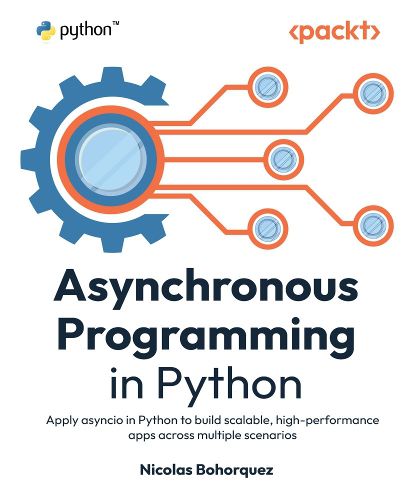
Take a practical journey through the core principles, concepts, and applications of asynchronous programming in Python across real-world environments and technologies.
Key Features
Understand core principles and theory behind async programming in Python Measure the impact of async techniques in practical, real-world use cases Apply async patterns in software design and data-oriented architectures
Book DescriptionAsynchronous programming is one of the most effective but often misunderstood techniques for building fast, scalable, and responsive systems in Python. While it can significantly improve performance, efficiency, and sustainability, using async without a clear understanding of its trade-offs can lead to fragile designs and hard-to-debug issues. This book offers a structured approach to applying asynchronous programming in Python. It begins with a conceptual framework to help you distinguish between synchronous and asynchronous execution models, and shows how async relates to other concurrency strategies such as multithreading and multiprocessing. From there, you will explore the core tools available for building async applications in Python. You will also learn how to measure the impact of async programming in practical scenarios, profile and debug asynchronous code, and evaluate performance improvements using real-world metrics. The final chapters focus on applying async techniques to common cloud-based systems, such as web frameworks, database interactions, and data-pipelines tools. Designed for developers looking to apply async programming with confidence, this book blends real-world examples with core concepts to help you write efficient, maintainable Python code.What you will learn
Use generators, coroutines and async/await to build scalable Python functions Explore event loops to manage concurrency and orchestrate async flow Compare concurrency models to choose the right async strategy Optimize I/O-intensive programs to improve system throughput and efficiency Build async services using real-world APIs and popular Python libraries Apply structured concurrency and design patterns for cleaner async design Test and debug async Python code to ensure reliability and stability
Who this book is forThis book will help Python developers who want to understand and apply the asynchronous programming model in application development, data analysis, and orchestration scenarios. Junior developers, data engineers,, and tech leads will also benefit from the application design examples.
$9.00 standard shipping within Australia
FREE standard shipping within Australia for orders over $100.00
Express & International shipping calculated at checkout
Stock availability can be subject to change without notice. We recommend calling the shop or contacting our online team to check availability of low stock items. Please see our Shopping Online page for more details.
This title is printed to order. This book may have been self-published. If so, we cannot guarantee the quality of the content. In the main most books will have gone through the editing process however some may not. We therefore suggest that you be aware of this before ordering this book. If in doubt check either the author or publisher’s details as we are unable to accept any returns unless they are faulty. Please contact us if you have any questions.
Take a practical journey through the core principles, concepts, and applications of asynchronous programming in Python across real-world environments and technologies.
Key Features
Understand core principles and theory behind async programming in Python Measure the impact of async techniques in practical, real-world use cases Apply async patterns in software design and data-oriented architectures
Book DescriptionAsynchronous programming is one of the most effective but often misunderstood techniques for building fast, scalable, and responsive systems in Python. While it can significantly improve performance, efficiency, and sustainability, using async without a clear understanding of its trade-offs can lead to fragile designs and hard-to-debug issues. This book offers a structured approach to applying asynchronous programming in Python. It begins with a conceptual framework to help you distinguish between synchronous and asynchronous execution models, and shows how async relates to other concurrency strategies such as multithreading and multiprocessing. From there, you will explore the core tools available for building async applications in Python. You will also learn how to measure the impact of async programming in practical scenarios, profile and debug asynchronous code, and evaluate performance improvements using real-world metrics. The final chapters focus on applying async techniques to common cloud-based systems, such as web frameworks, database interactions, and data-pipelines tools. Designed for developers looking to apply async programming with confidence, this book blends real-world examples with core concepts to help you write efficient, maintainable Python code.What you will learn
Use generators, coroutines and async/await to build scalable Python functions Explore event loops to manage concurrency and orchestrate async flow Compare concurrency models to choose the right async strategy Optimize I/O-intensive programs to improve system throughput and efficiency Build async services using real-world APIs and popular Python libraries Apply structured concurrency and design patterns for cleaner async design Test and debug async Python code to ensure reliability and stability
Who this book is forThis book will help Python developers who want to understand and apply the asynchronous programming model in application development, data analysis, and orchestration scenarios. Junior developers, data engineers,, and tech leads will also benefit from the application design examples.
Search our extensive online catalogue.
