Readings Newsletter
Become a Readings Member to make your shopping experience even easier.
Sign in or sign up for free!
You’re not far away from qualifying for FREE standard shipping within Australia
You’ve qualified for FREE standard shipping within Australia
The cart is loading…


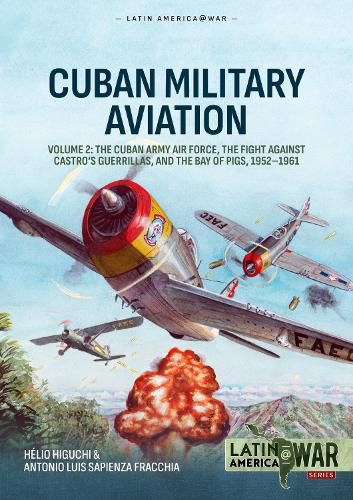
In 1952, the Cuban Army Air Corps (Cuerpo de Aviacion del Ejercito de Cuba, CAEC) was reorganised into the Cuban Army Air Force (Fuerza Aerea del Ejercito de Cuba, FAEC), and the Cuban Naval Aviation came into being. Like many other Latin American countries, Cuban history has been marked by tumultuous political developments, multiple military coups d'etat, and several military dictatorships. In the mid-1950s, an armed insurgency of the M-26-7 movement, led by the Castro brothers and Che Guevara, erupted in the Sierra Maestra area and began spreading into the major urban centres. The FAEC was heavily involved in counterinsurgency operations and massively accelerated its growth through the acquisition of additional aircraft and first helicopters. By 1958, the last year of the ensuing civil war, the air force greatly intensified its operations. The insurgents established their own flying branch, the Rebel Air Force (Fuerza Aerea Rebelde, FAR): equipped with warbirds obtained from the USA, this was primarily utilised to haul clandestine arms shipments. Eventually, the corruption, prebendary, and nepotism within the government and the senior leadership of the armed forces, eventually tipped the balance in favour of the revolutionary forces. The turning point occurred on 1 January 1959, when the dictatorship of General Fulgencio Batista abruptly ended and a revolutionary regime established itself in power. This resulted in dramatic changes for the FAEC, which was reorganized as the Revolutionary Air Force (Fuerza Aerea Revolucionaria, FAR) and, only two years later, had to fight against the US-supported Brigade 2506 of the Cuban exiles during the Bay of Pigs invasion. Cuban Military Aviation: Volume 2 1952?1962 is richly illustrated throughout with original photographs and the @War series' signature specially commissioned colour artworks. AUTHORS: Helio Higuchi was born in Sao Paulo, Brazil on 12 November 1953. He graduated in Architecture and Urban Planning, with a postgraduate degree in Marketing, and has been working in the hotel sector. His main hobby is doing research on military history and its respective equipment in Latin American countries. He is the author of several books on Latin American military aviation and armored vehicles, as well as numerous articles in specialised magazines from Brazil, the United States and England. Antonio Luis Sapienza Fracchia was born in Asuncion, Paraguay on 14 May 1960. He graduated from the Catholic University of Asuncion where he got a B.A. in Clinical Psychology. He also took specialized English courses at Tulane University of New Orleans, Louisiana, USA and San Diego State University in California. He is now retired but worked for nearly 40 years as an English Teacher and one of the Academic Coordinators at the Centro Cultural Paraguayo-Americano (CCPA), a binational institute in Asuncion. Married with two children, he resides in the capital. He is an Aviation Historian who wrote more than 500 articles in specialized magazines and web pages on the Paraguayan Aviation history, and has given numerous lectures in schools, universities, institutes, military and civil institutions in Paraguay and abroad. Since 2004 he has been an aviation history professor in the Paraguayan Air Force (FAP). He has published thirty books since 1996, being this one his eighteenth with Helion. He received a total of seven decorations for his academic merits, two from Argentina, one from Brazil and four from his own country, Paraguay. 140 b/w photos, 8pp colour illustrations, 4 b/w maps
$9.00 standard shipping within Australia
FREE standard shipping within Australia for orders over $100.00
Express & International shipping calculated at checkout
Stock availability can be subject to change without notice. We recommend calling the shop or contacting our online team to check availability of low stock items. Please see our Shopping Online page for more details.
In 1952, the Cuban Army Air Corps (Cuerpo de Aviacion del Ejercito de Cuba, CAEC) was reorganised into the Cuban Army Air Force (Fuerza Aerea del Ejercito de Cuba, FAEC), and the Cuban Naval Aviation came into being. Like many other Latin American countries, Cuban history has been marked by tumultuous political developments, multiple military coups d'etat, and several military dictatorships. In the mid-1950s, an armed insurgency of the M-26-7 movement, led by the Castro brothers and Che Guevara, erupted in the Sierra Maestra area and began spreading into the major urban centres. The FAEC was heavily involved in counterinsurgency operations and massively accelerated its growth through the acquisition of additional aircraft and first helicopters. By 1958, the last year of the ensuing civil war, the air force greatly intensified its operations. The insurgents established their own flying branch, the Rebel Air Force (Fuerza Aerea Rebelde, FAR): equipped with warbirds obtained from the USA, this was primarily utilised to haul clandestine arms shipments. Eventually, the corruption, prebendary, and nepotism within the government and the senior leadership of the armed forces, eventually tipped the balance in favour of the revolutionary forces. The turning point occurred on 1 January 1959, when the dictatorship of General Fulgencio Batista abruptly ended and a revolutionary regime established itself in power. This resulted in dramatic changes for the FAEC, which was reorganized as the Revolutionary Air Force (Fuerza Aerea Revolucionaria, FAR) and, only two years later, had to fight against the US-supported Brigade 2506 of the Cuban exiles during the Bay of Pigs invasion. Cuban Military Aviation: Volume 2 1952?1962 is richly illustrated throughout with original photographs and the @War series' signature specially commissioned colour artworks. AUTHORS: Helio Higuchi was born in Sao Paulo, Brazil on 12 November 1953. He graduated in Architecture and Urban Planning, with a postgraduate degree in Marketing, and has been working in the hotel sector. His main hobby is doing research on military history and its respective equipment in Latin American countries. He is the author of several books on Latin American military aviation and armored vehicles, as well as numerous articles in specialised magazines from Brazil, the United States and England. Antonio Luis Sapienza Fracchia was born in Asuncion, Paraguay on 14 May 1960. He graduated from the Catholic University of Asuncion where he got a B.A. in Clinical Psychology. He also took specialized English courses at Tulane University of New Orleans, Louisiana, USA and San Diego State University in California. He is now retired but worked for nearly 40 years as an English Teacher and one of the Academic Coordinators at the Centro Cultural Paraguayo-Americano (CCPA), a binational institute in Asuncion. Married with two children, he resides in the capital. He is an Aviation Historian who wrote more than 500 articles in specialized magazines and web pages on the Paraguayan Aviation history, and has given numerous lectures in schools, universities, institutes, military and civil institutions in Paraguay and abroad. Since 2004 he has been an aviation history professor in the Paraguayan Air Force (FAP). He has published thirty books since 1996, being this one his eighteenth with Helion. He received a total of seven decorations for his academic merits, two from Argentina, one from Brazil and four from his own country, Paraguay. 140 b/w photos, 8pp colour illustrations, 4 b/w maps
Search our extensive online catalogue.
