Readings Newsletter
Become a Readings Member to make your shopping experience even easier.
Sign in or sign up for free!
You’re not far away from qualifying for FREE standard shipping within Australia
You’ve qualified for FREE standard shipping within Australia
The cart is loading…


This title is printed to order. This book may have been self-published. If so, we cannot guarantee the quality of the content. In the main most books will have gone through the editing process however some may not. We therefore suggest that you be aware of this before ordering this book. If in doubt check either the author or publisher’s details as we are unable to accept any returns unless they are faulty. Please contact us if you have any questions.
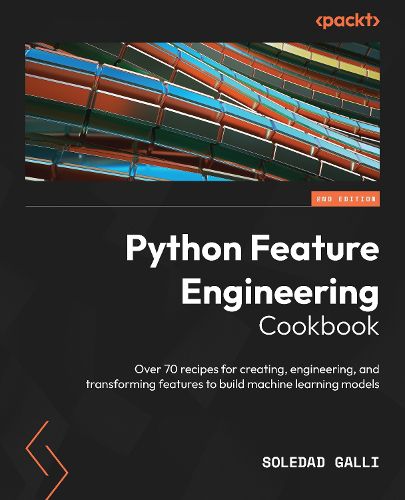
Create end-to-end, reproducible feature engineering pipelines that can be deployed into production using open-source Python libraries
Key Features
Learn and implement feature engineering best practices Reinforce your learning with the help of multiple hands-on recipes Build end-to-end feature engineering pipelines that are performant and reproducible
Book DescriptionFeature engineering, the process of transforming variables and creating features, albeit time-consuming, ensures that your machine learning models perform seamlessly. This second edition of Python Feature Engineering Cookbook will take the struggle out of feature engineering by showing you how to use open source Python libraries to accelerate the process via a plethora of practical, hands-on recipes.
This updated edition begins by addressing fundamental data challenges such as missing data and categorical values, before moving on to strategies for dealing with skewed distributions and outliers. The concluding chapters show you how to develop new features from various types of data, including text, time series, and relational databases. With the help of numerous open source Python libraries, you'll learn how to implement each feature engineering method in a performant, reproducible, and elegant manner.
By the end of this Python book, you will have the tools and expertise needed to confidently build end-to-end and reproducible feature engineering pipelines that can be deployed into production.What you will learn
Impute missing data using various univariate and multivariate methods Encode categorical variables with one-hot, ordinal, and count encoding Handle highly cardinal categorical variables Transform, discretize, and scale your variables Create variables from date and time with pandas and Feature-engine Combine variables into new features Extract features from text as well as from transactional data with Featuretools Create features from time series data with tsfresh
Who this book is forThis book is for machine learning and data science students and professionals, as well as software engineers working on machine learning model deployment, who want to learn more about how to transform their data and create new features to train machine learning models in a better way.
$9.00 standard shipping within Australia
FREE standard shipping within Australia for orders over $100.00
Express & International shipping calculated at checkout
Stock availability can be subject to change without notice. We recommend calling the shop or contacting our online team to check availability of low stock items. Please see our Shopping Online page for more details.
This title is printed to order. This book may have been self-published. If so, we cannot guarantee the quality of the content. In the main most books will have gone through the editing process however some may not. We therefore suggest that you be aware of this before ordering this book. If in doubt check either the author or publisher’s details as we are unable to accept any returns unless they are faulty. Please contact us if you have any questions.
Create end-to-end, reproducible feature engineering pipelines that can be deployed into production using open-source Python libraries
Key Features
Learn and implement feature engineering best practices Reinforce your learning with the help of multiple hands-on recipes Build end-to-end feature engineering pipelines that are performant and reproducible
Book DescriptionFeature engineering, the process of transforming variables and creating features, albeit time-consuming, ensures that your machine learning models perform seamlessly. This second edition of Python Feature Engineering Cookbook will take the struggle out of feature engineering by showing you how to use open source Python libraries to accelerate the process via a plethora of practical, hands-on recipes.
This updated edition begins by addressing fundamental data challenges such as missing data and categorical values, before moving on to strategies for dealing with skewed distributions and outliers. The concluding chapters show you how to develop new features from various types of data, including text, time series, and relational databases. With the help of numerous open source Python libraries, you'll learn how to implement each feature engineering method in a performant, reproducible, and elegant manner.
By the end of this Python book, you will have the tools and expertise needed to confidently build end-to-end and reproducible feature engineering pipelines that can be deployed into production.What you will learn
Impute missing data using various univariate and multivariate methods Encode categorical variables with one-hot, ordinal, and count encoding Handle highly cardinal categorical variables Transform, discretize, and scale your variables Create variables from date and time with pandas and Feature-engine Combine variables into new features Extract features from text as well as from transactional data with Featuretools Create features from time series data with tsfresh
Who this book is forThis book is for machine learning and data science students and professionals, as well as software engineers working on machine learning model deployment, who want to learn more about how to transform their data and create new features to train machine learning models in a better way.
Search our extensive online catalogue.
