Readings Newsletter
Become a Readings Member to make your shopping experience even easier.
Sign in or sign up for free!
You’re not far away from qualifying for FREE standard shipping within Australia
You’ve qualified for FREE standard shipping within Australia
The cart is loading…


This title is printed to order. This book may have been self-published. If so, we cannot guarantee the quality of the content. In the main most books will have gone through the editing process however some may not. We therefore suggest that you be aware of this before ordering this book. If in doubt check either the author or publisher’s details as we are unable to accept any returns unless they are faulty. Please contact us if you have any questions.
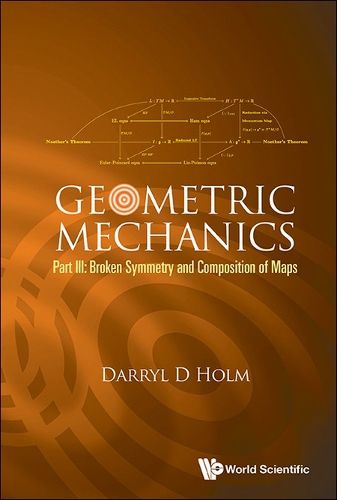
Geometric Mechanics: Part III is a textbook presented in a lecture notes format, providing precise definitions and practical examples across a series of 31 lectures that have been developed from the author's extensive experience of teaching and research. Geometric mechanics is an incredibly rich field of study: beyond its mathematical depth and beauty, it provides a robust framework for exploring the geometric structures underpinning many dynamical systems crucial to physics.The first part introduces undergraduate mathematics and physics students to the applications of geometric mechanics in finite dimensional dynamical systems of ordinary differential equations. The second part covers the essential theory of manifolds and Lie groups to prepare senior undergraduates and graduate students for the modern applications of geometric mechanics. These applications are introduced in the third part, which delves into the geometric mechanics of partial differential equations that govern the dynamics of ideal continuum mechanics, including fluids and plasmas, at the cutting edge of current research.This textbook is designed to facilitate both course learning and individual study. With focused notes, numerous examples, and nearly 200 exercises, it serves as a valuable resource for postgraduate students, course instructors, and researchers.
$9.00 standard shipping within Australia
FREE standard shipping within Australia for orders over $100.00
Express & International shipping calculated at checkout
Stock availability can be subject to change without notice. We recommend calling the shop or contacting our online team to check availability of low stock items. Please see our Shopping Online page for more details.
This title is printed to order. This book may have been self-published. If so, we cannot guarantee the quality of the content. In the main most books will have gone through the editing process however some may not. We therefore suggest that you be aware of this before ordering this book. If in doubt check either the author or publisher’s details as we are unable to accept any returns unless they are faulty. Please contact us if you have any questions.
Geometric Mechanics: Part III is a textbook presented in a lecture notes format, providing precise definitions and practical examples across a series of 31 lectures that have been developed from the author's extensive experience of teaching and research. Geometric mechanics is an incredibly rich field of study: beyond its mathematical depth and beauty, it provides a robust framework for exploring the geometric structures underpinning many dynamical systems crucial to physics.The first part introduces undergraduate mathematics and physics students to the applications of geometric mechanics in finite dimensional dynamical systems of ordinary differential equations. The second part covers the essential theory of manifolds and Lie groups to prepare senior undergraduates and graduate students for the modern applications of geometric mechanics. These applications are introduced in the third part, which delves into the geometric mechanics of partial differential equations that govern the dynamics of ideal continuum mechanics, including fluids and plasmas, at the cutting edge of current research.This textbook is designed to facilitate both course learning and individual study. With focused notes, numerous examples, and nearly 200 exercises, it serves as a valuable resource for postgraduate students, course instructors, and researchers.
Search our extensive online catalogue.
