Readings Newsletter
Become a Readings Member to make your shopping experience even easier.
Sign in or sign up for free!
You’re not far away from qualifying for FREE standard shipping within Australia
You’ve qualified for FREE standard shipping within Australia
The cart is loading…


This title is printed to order. This book may have been self-published. If so, we cannot guarantee the quality of the content. In the main most books will have gone through the editing process however some may not. We therefore suggest that you be aware of this before ordering this book. If in doubt check either the author or publisher’s details as we are unable to accept any returns unless they are faulty. Please contact us if you have any questions.
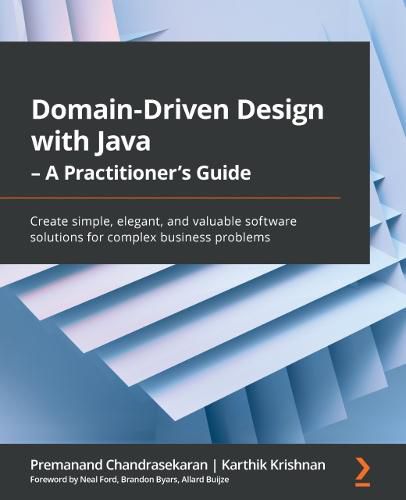
Adopt a practical and modern approach to architecting and implementing DDD-inspired solutions to transform abstract business ideas into working software across the entire spectrum of the software development life cycle
Key Features
Implement DDD principles to build simple, effective, and well-factored solutions Use lightweight modeling techniques to arrive at a common collective understanding of the problem domain Decompose monolithic applications into loosely coupled, distributed components using modern design patterns
Book DescriptionDomain-Driven Design (DDD) makes available a set of techniques and patterns that enable domain experts, architects, and developers to work together to decompose complex business problems into a set of well-factored, collaborating, and loosely coupled subsystems.
This practical guide will help you as a developer and architect to put your knowledge to work in order to create elegant software designs that are enjoyable to work with and easy to reason about. You’ll begin with an introduction to the concepts of domain-driven design and discover various ways to apply them in real-world scenarios. You’ll also appreciate how DDD is extremely relevant when creating cloud native solutions that employ modern techniques such as event-driven microservices and fine-grained architectures. As you advance through the chapters, you’ll get acquainted with core DDD’s strategic design concepts such as the ubiquitous language, context maps, bounded contexts, and tactical design elements like aggregates and domain models and events. You’ll understand how to apply modern, lightweight modeling techniques such as business value canvas, Wardley mapping, domain storytelling, and event storming, while also learning how to test-drive the system to create solutions that exhibit high degrees of internal quality.
By the end of this software design book, you’ll be able to architect, design, and implement robust, resilient, and performant distributed software solutions.
What you will learn
Discover how to develop a shared understanding of the problem domain Establish a clear demarcation between core and peripheral systems Identify how to evolve and decompose complex systems into well-factored components Apply elaboration techniques like domain storytelling and event storming Implement EDA, CQRS, event sourcing, and much more Design an ecosystem of cohesive, loosely coupled, and distributed microservices Test-drive the implementation of an event-driven system in Java Grasp how non-functional requirements influence bounded context decompositions
Who this book is forThis book is for intermediate Java programmers looking to upgrade their software engineering skills and adopt a collaborative and structured approach to designing complex software systems. Specifically, the book will assist senior developers and hands-on architects to gain a deeper understanding of domain-driven design and implement it in their organization. Familiarity with DDD techniques is not a prerequisite; however, working knowledge of Java is expected.
$9.00 standard shipping within Australia
FREE standard shipping within Australia for orders over $100.00
Express & International shipping calculated at checkout
Stock availability can be subject to change without notice. We recommend calling the shop or contacting our online team to check availability of low stock items. Please see our Shopping Online page for more details.
This title is printed to order. This book may have been self-published. If so, we cannot guarantee the quality of the content. In the main most books will have gone through the editing process however some may not. We therefore suggest that you be aware of this before ordering this book. If in doubt check either the author or publisher’s details as we are unable to accept any returns unless they are faulty. Please contact us if you have any questions.
Adopt a practical and modern approach to architecting and implementing DDD-inspired solutions to transform abstract business ideas into working software across the entire spectrum of the software development life cycle
Key Features
Implement DDD principles to build simple, effective, and well-factored solutions Use lightweight modeling techniques to arrive at a common collective understanding of the problem domain Decompose monolithic applications into loosely coupled, distributed components using modern design patterns
Book DescriptionDomain-Driven Design (DDD) makes available a set of techniques and patterns that enable domain experts, architects, and developers to work together to decompose complex business problems into a set of well-factored, collaborating, and loosely coupled subsystems.
This practical guide will help you as a developer and architect to put your knowledge to work in order to create elegant software designs that are enjoyable to work with and easy to reason about. You’ll begin with an introduction to the concepts of domain-driven design and discover various ways to apply them in real-world scenarios. You’ll also appreciate how DDD is extremely relevant when creating cloud native solutions that employ modern techniques such as event-driven microservices and fine-grained architectures. As you advance through the chapters, you’ll get acquainted with core DDD’s strategic design concepts such as the ubiquitous language, context maps, bounded contexts, and tactical design elements like aggregates and domain models and events. You’ll understand how to apply modern, lightweight modeling techniques such as business value canvas, Wardley mapping, domain storytelling, and event storming, while also learning how to test-drive the system to create solutions that exhibit high degrees of internal quality.
By the end of this software design book, you’ll be able to architect, design, and implement robust, resilient, and performant distributed software solutions.
What you will learn
Discover how to develop a shared understanding of the problem domain Establish a clear demarcation between core and peripheral systems Identify how to evolve and decompose complex systems into well-factored components Apply elaboration techniques like domain storytelling and event storming Implement EDA, CQRS, event sourcing, and much more Design an ecosystem of cohesive, loosely coupled, and distributed microservices Test-drive the implementation of an event-driven system in Java Grasp how non-functional requirements influence bounded context decompositions
Who this book is forThis book is for intermediate Java programmers looking to upgrade their software engineering skills and adopt a collaborative and structured approach to designing complex software systems. Specifically, the book will assist senior developers and hands-on architects to gain a deeper understanding of domain-driven design and implement it in their organization. Familiarity with DDD techniques is not a prerequisite; however, working knowledge of Java is expected.
Search our extensive online catalogue.
