Readings Newsletter
Become a Readings Member to make your shopping experience even easier.
Sign in or sign up for free!
You’re not far away from qualifying for FREE standard shipping within Australia
You’ve qualified for FREE standard shipping within Australia
The cart is loading…


This title is printed to order. This book may have been self-published. If so, we cannot guarantee the quality of the content. In the main most books will have gone through the editing process however some may not. We therefore suggest that you be aware of this before ordering this book. If in doubt check either the author or publisher’s details as we are unable to accept any returns unless they are faulty. Please contact us if you have any questions.
Leverage the power of reward-based training for your deep learning models with Python
Key Features
Understand Q-learning algorithms to train neural networks using Markov Decision Process (MDP) Study practical deep reinforcement learning using Q-Networks Explore state-based unsupervised learning for machine learning models
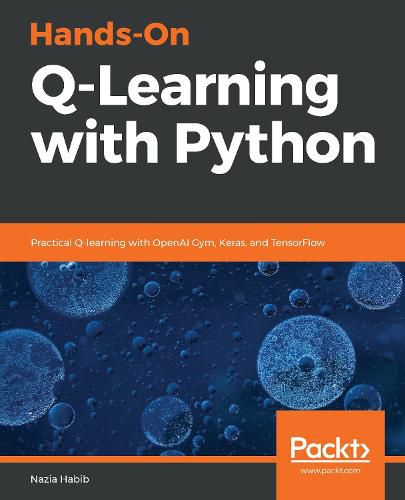
Book DescriptionQ-learning is a machine learning algorithm used to solve optimization problems in artificial intelligence (AI). It is one of the most popular fields of study among AI researchers.
This book starts off by introducing you to reinforcement learning and Q-learning, in addition to helping you get familiar with OpenAI Gym as well as libraries such as Keras and TensorFlow. A few chapters into the book, you will gain insights into modelfree Q-learning and use deep Q-networks and double deep Q-networks to solve complex problems. This book will guide you in exploring use cases such as self-driving vehicles and OpenAI Gym’s CartPole problem. You will also learn how to tune and optimize Q-networks and their hyperparameters. As you progress, you will understand the reinforcement learning approach to solving real-world problems. You will also explore how to use Q-learning and related algorithms in real-world applications such as scientific research. Toward the end, you’ll gain a sense of what’s in store for reinforcement learning.
By the end of this book, you will be equipped with the skills you need to solve reinforcement learning problems using Q-learning algorithms with OpenAI Gym, Keras, and TensorFlow.
What you will learn
Explore the fundamentals of reinforcement learning and the state-action-reward process Understand Markov decision processes Get well versed with libraries such as Keras, and TensorFlow Create and deploy model-free learning and deep Q-learning agents with TensorFlow, Keras, and OpenAI Gym Choose and optimize a Q-Network’s learning parameters and fine-tune its performance Discover real-world applications and use cases of Q-learning
Who this book is forIf you are a machine learning developer, engineer, or professional who wants to delve into the deep learning approach for a complex environment, then this is the book for you. Proficiency in Python programming and basic understanding of decision-making in reinforcement learning is assumed.
$9.00 standard shipping within Australia
FREE standard shipping within Australia for orders over $100.00
Express & International shipping calculated at checkout
Stock availability can be subject to change without notice. We recommend calling the shop or contacting our online team to check availability of low stock items. Please see our Shopping Online page for more details.
This title is printed to order. This book may have been self-published. If so, we cannot guarantee the quality of the content. In the main most books will have gone through the editing process however some may not. We therefore suggest that you be aware of this before ordering this book. If in doubt check either the author or publisher’s details as we are unable to accept any returns unless they are faulty. Please contact us if you have any questions.
Leverage the power of reward-based training for your deep learning models with Python
Key Features
Understand Q-learning algorithms to train neural networks using Markov Decision Process (MDP) Study practical deep reinforcement learning using Q-Networks Explore state-based unsupervised learning for machine learning models
Book DescriptionQ-learning is a machine learning algorithm used to solve optimization problems in artificial intelligence (AI). It is one of the most popular fields of study among AI researchers.
This book starts off by introducing you to reinforcement learning and Q-learning, in addition to helping you get familiar with OpenAI Gym as well as libraries such as Keras and TensorFlow. A few chapters into the book, you will gain insights into modelfree Q-learning and use deep Q-networks and double deep Q-networks to solve complex problems. This book will guide you in exploring use cases such as self-driving vehicles and OpenAI Gym’s CartPole problem. You will also learn how to tune and optimize Q-networks and their hyperparameters. As you progress, you will understand the reinforcement learning approach to solving real-world problems. You will also explore how to use Q-learning and related algorithms in real-world applications such as scientific research. Toward the end, you’ll gain a sense of what’s in store for reinforcement learning.
By the end of this book, you will be equipped with the skills you need to solve reinforcement learning problems using Q-learning algorithms with OpenAI Gym, Keras, and TensorFlow.
What you will learn
Explore the fundamentals of reinforcement learning and the state-action-reward process Understand Markov decision processes Get well versed with libraries such as Keras, and TensorFlow Create and deploy model-free learning and deep Q-learning agents with TensorFlow, Keras, and OpenAI Gym Choose and optimize a Q-Network’s learning parameters and fine-tune its performance Discover real-world applications and use cases of Q-learning
Who this book is forIf you are a machine learning developer, engineer, or professional who wants to delve into the deep learning approach for a complex environment, then this is the book for you. Proficiency in Python programming and basic understanding of decision-making in reinforcement learning is assumed.
Search our extensive online catalogue.
