Readings Newsletter
Become a Readings Member to make your shopping experience even easier.
Sign in or sign up for free!
You’re not far away from qualifying for FREE standard shipping within Australia
You’ve qualified for FREE standard shipping within Australia
The cart is loading…


This title is printed to order. This book may have been self-published. If so, we cannot guarantee the quality of the content. In the main most books will have gone through the editing process however some may not. We therefore suggest that you be aware of this before ordering this book. If in doubt check either the author or publisher’s details as we are unable to accept any returns unless they are faulty. Please contact us if you have any questions.
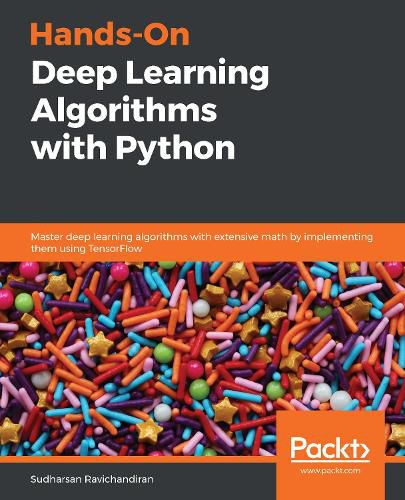
Understand basic to advanced deep learning algorithms, the mathematical principles behind them, and their practical applications.
Key Features
Get up-to-speed with building your own neural networks from scratch
Gain insights into the mathematical principles behind deep learning algorithms Implement popular deep learning algorithms such as CNNs, RNNs, and more using TensorFlow
Book DescriptionDeep learning is one of the most popular domains in the AI space, allowing you to develop multi-layered models of varying complexities.
This book introduces you to popular deep learning algorithms-from basic to advanced-and shows you how to implement them from scratch using TensorFlow. Throughout the book, you will gain insights into each algorithm, the mathematical principles behind it, and how to implement it in the best possible manner. The book starts by explaining how you can build your own neural networks, followed by introducing you to TensorFlow, the powerful Python-based library for machine learning and deep learning. Moving on, you will get up to speed with gradient descent variants, such as NAG, AMSGrad, AdaDelta, Adam, and Nadam. The book will then provide you with insights into RNNs and LSTM and how to generate song lyrics with RNN. Next, you will master the math for convolutional and capsule networks, widely used for image recognition tasks. Then you learn how machines understand the semantics of words and documents using CBOW, skip-gram, and PV-DM. Afterward, you will explore various GANs, including InfoGAN and LSGAN, and autoencoders, such as contractive autoencoders and VAE.
By the end of this book, you will be equipped with all the skills you need to implement deep learning in your own projects.
What you will learn
Implement basic-to-advanced deep learning algorithms Master the mathematics behind deep learning algorithms Become familiar with gradient descent and its variants, such as AMSGrad, AdaDelta, Adam, and Nadam Implement recurrent networks, such as RNN, LSTM, GRU, and seq2seq models Understand how machines interpret images using CNN and capsule networks Implement different types of generative adversarial network, such as CGAN, CycleGAN, and StackGAN Explore various types of autoencoder, such as Sparse autoencoders, DAE, CAE, and VAE
Who this book is forIf you are a machine learning engineer, data scientist, AI developer, or simply want to focus on neural networks and deep learning, this book is for you. Those who are completely new to deep learning, but have some experience in machine learning and Python programming, will also find the book very helpful.
$9.00 standard shipping within Australia
FREE standard shipping within Australia for orders over $100.00
Express & International shipping calculated at checkout
Stock availability can be subject to change without notice. We recommend calling the shop or contacting our online team to check availability of low stock items. Please see our Shopping Online page for more details.
This title is printed to order. This book may have been self-published. If so, we cannot guarantee the quality of the content. In the main most books will have gone through the editing process however some may not. We therefore suggest that you be aware of this before ordering this book. If in doubt check either the author or publisher’s details as we are unable to accept any returns unless they are faulty. Please contact us if you have any questions.
Understand basic to advanced deep learning algorithms, the mathematical principles behind them, and their practical applications.
Key Features
Get up-to-speed with building your own neural networks from scratch
Gain insights into the mathematical principles behind deep learning algorithms Implement popular deep learning algorithms such as CNNs, RNNs, and more using TensorFlow
Book DescriptionDeep learning is one of the most popular domains in the AI space, allowing you to develop multi-layered models of varying complexities.
This book introduces you to popular deep learning algorithms-from basic to advanced-and shows you how to implement them from scratch using TensorFlow. Throughout the book, you will gain insights into each algorithm, the mathematical principles behind it, and how to implement it in the best possible manner. The book starts by explaining how you can build your own neural networks, followed by introducing you to TensorFlow, the powerful Python-based library for machine learning and deep learning. Moving on, you will get up to speed with gradient descent variants, such as NAG, AMSGrad, AdaDelta, Adam, and Nadam. The book will then provide you with insights into RNNs and LSTM and how to generate song lyrics with RNN. Next, you will master the math for convolutional and capsule networks, widely used for image recognition tasks. Then you learn how machines understand the semantics of words and documents using CBOW, skip-gram, and PV-DM. Afterward, you will explore various GANs, including InfoGAN and LSGAN, and autoencoders, such as contractive autoencoders and VAE.
By the end of this book, you will be equipped with all the skills you need to implement deep learning in your own projects.
What you will learn
Implement basic-to-advanced deep learning algorithms Master the mathematics behind deep learning algorithms Become familiar with gradient descent and its variants, such as AMSGrad, AdaDelta, Adam, and Nadam Implement recurrent networks, such as RNN, LSTM, GRU, and seq2seq models Understand how machines interpret images using CNN and capsule networks Implement different types of generative adversarial network, such as CGAN, CycleGAN, and StackGAN Explore various types of autoencoder, such as Sparse autoencoders, DAE, CAE, and VAE
Who this book is forIf you are a machine learning engineer, data scientist, AI developer, or simply want to focus on neural networks and deep learning, this book is for you. Those who are completely new to deep learning, but have some experience in machine learning and Python programming, will also find the book very helpful.
Search our extensive online catalogue.
