Readings Newsletter
Become a Readings Member to make your shopping experience even easier.
Sign in or sign up for free!
You’re not far away from qualifying for FREE standard shipping within Australia
You’ve qualified for FREE standard shipping within Australia
The cart is loading…


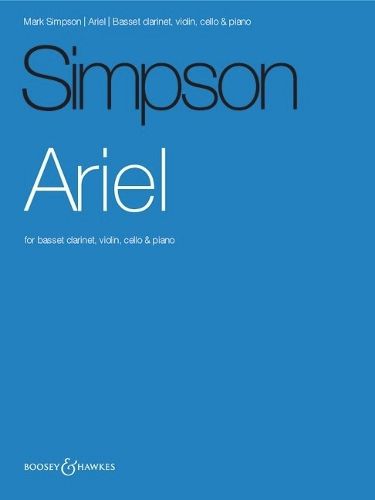
(Boosey & Hawkes Chamber Music). Ariel is scored for basset clarinet, violin, cello and piano, and is a response to the poem of the same name by Sylvia Plath. Simpson reacted to the poem musically, jotting down the ideas for instrumental combinations, as well as the emotional content as he read the words. The piece begins, ('Stasis in darkness...') and gradually wakens up to a furious outburst in all the instruments. Scales descend to the depths of the instruments ranges, out of which a slow, winding duet for basset clarinet and cello leads to the centre of the work a slow, calm three-chord chorale. The work then comes to a stand-still where short outbursts are gradually transformed into new, faster material. The three-chord chorale motif then goes through a number of permutations until a recap of the opening's outburst is quickly side-lined by a boldly expressive return of the chorale motif. This piece is about extremes extremes of expression, of instrumental textures and capabilities.
$9.00 standard shipping within Australia
FREE standard shipping within Australia for orders over $100.00
Express & International shipping calculated at checkout
Stock availability can be subject to change without notice. We recommend calling the shop or contacting our online team to check availability of low stock items. Please see our Shopping Online page for more details.
(Boosey & Hawkes Chamber Music). Ariel is scored for basset clarinet, violin, cello and piano, and is a response to the poem of the same name by Sylvia Plath. Simpson reacted to the poem musically, jotting down the ideas for instrumental combinations, as well as the emotional content as he read the words. The piece begins, ('Stasis in darkness...') and gradually wakens up to a furious outburst in all the instruments. Scales descend to the depths of the instruments ranges, out of which a slow, winding duet for basset clarinet and cello leads to the centre of the work a slow, calm three-chord chorale. The work then comes to a stand-still where short outbursts are gradually transformed into new, faster material. The three-chord chorale motif then goes through a number of permutations until a recap of the opening's outburst is quickly side-lined by a boldly expressive return of the chorale motif. This piece is about extremes extremes of expression, of instrumental textures and capabilities.
Search our extensive online catalogue.
