Readings Newsletter
Become a Readings Member to make your shopping experience even easier.
Sign in or sign up for free!
You’re not far away from qualifying for FREE standard shipping within Australia
You’ve qualified for FREE standard shipping within Australia
The cart is loading…


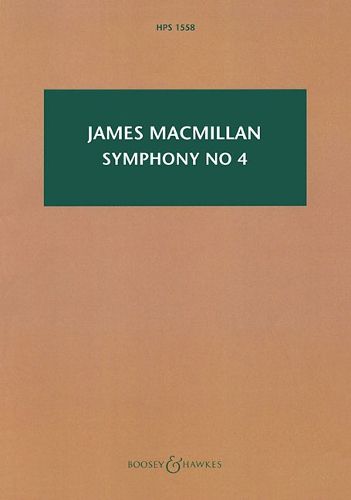
(Boosey & Hawkes Scores/Books). Unlike MacMillan’s first three symphonies, Symphony No. 4 (2014-15) is essentially abstract. Here he is interested in the interplay of different types of material, following upon a fascination with music as ritual that has stretched from Monteverdi in the early 17th century through to Boulez and Birtwistle in the present day. There are four distinct archetypes in this work, which can be viewed as rituals of movement, exhortation, petition and joy. It is also a homage to Robert Carver (c1487-after 1566), the most important Scottish composer of the High Renaissance. There are allusions to Carver’s 10-voice Mass Dum sacrum mysterium embedded in the symphony, and at a number of points it emerges from across the centuries in a more discernible form: the vocal lines are muted and muffled, literally in the distance, as they are played delicately by the back desks of the violas, cellos and double basses. Suitable for advanced standard performers.
$9.00 standard shipping within Australia
FREE standard shipping within Australia for orders over $100.00
Express & International shipping calculated at checkout
Stock availability can be subject to change without notice. We recommend calling the shop or contacting our online team to check availability of low stock items. Please see our Shopping Online page for more details.
(Boosey & Hawkes Scores/Books). Unlike MacMillan’s first three symphonies, Symphony No. 4 (2014-15) is essentially abstract. Here he is interested in the interplay of different types of material, following upon a fascination with music as ritual that has stretched from Monteverdi in the early 17th century through to Boulez and Birtwistle in the present day. There are four distinct archetypes in this work, which can be viewed as rituals of movement, exhortation, petition and joy. It is also a homage to Robert Carver (c1487-after 1566), the most important Scottish composer of the High Renaissance. There are allusions to Carver’s 10-voice Mass Dum sacrum mysterium embedded in the symphony, and at a number of points it emerges from across the centuries in a more discernible form: the vocal lines are muted and muffled, literally in the distance, as they are played delicately by the back desks of the violas, cellos and double basses. Suitable for advanced standard performers.
Search our extensive online catalogue.
