Readings Newsletter
Become a Readings Member to make your shopping experience even easier.
Sign in or sign up for free!
You’re not far away from qualifying for FREE standard shipping within Australia
You’ve qualified for FREE standard shipping within Australia
The cart is loading…


This title is printed to order. This book may have been self-published. If so, we cannot guarantee the quality of the content. In the main most books will have gone through the editing process however some may not. We therefore suggest that you be aware of this before ordering this book. If in doubt check either the author or publisher’s details as we are unable to accept any returns unless they are faulty. Please contact us if you have any questions.
This pamphlet was prepared for the Historical Division, EUCOM, by a group of former German generals and general staff officers. The names of the contributors were not announced at the time. The principal author, who by the end of the war had attained the rank of general (Generaloberst), served on the Eastern Front throughout the Russian campaign and the subsequent retreat into the plains of northern Germany. He was successively commander of an infantry brigade, a panzer division (November 1941 to February 1943), and two different corps in the battles for Kharkov and Belgorod. Appointed commander of a panzer army on 1 December 1943, he participated in the withdrawal across southern Russia until the Germans reached the Carpathians. In August 1944 he was transferred to Army Group Center, and his last assignment was with Army Group Weichsel. During this final phase of his military career, he played an important part in the retreat from Lithuania, East Prussia, and Pomerania.
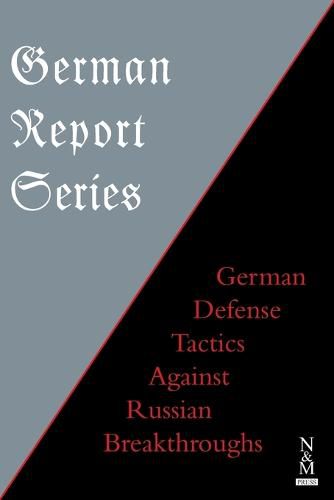
By means of short narratives based on actual experiences, this study endeavors to describe the characteristics of Russian Breakthroughs and the countermeasures employed by the Germans. A few combat narratives contain other than strictly tactical details in an effort to convey some of the emotional factors which affected the actions of troop commanders and their men in different situations.
Each of the chapters deals with one of the more frequently employed tactics to prevent or contain breakthroughs. It should be pointed out, however, that only in rare instances was one single method used. Most often one tactical measure predominated in an operation, with two or three others, or even more, complementing it. During extended defensive operations even the predominant method changed occasionally. The use of combination of defense tactics without preponderance of any one often proved effective. On many occasions the parent unit employed one specific defense method while its subordinate unit had to use other tactics. No two situations were alike, and each had to be treated on its own merits. The selection of the type of defensive tactics depended on the intuitive perception of the commander in the field as well as upon the circumstances.
By means of short narratives based on actual experiences, this study describes the characteristics of Russian Breakthroughs and the countermeasures employed by the Germans. A few combat narratives contain other than strictly tactical details in an effort to convey some of the emotional factors which affected the actions of troop commanders and their men in different situations.
$9.00 standard shipping within Australia
FREE standard shipping within Australia for orders over $100.00
Express & International shipping calculated at checkout
Stock availability can be subject to change without notice. We recommend calling the shop or contacting our online team to check availability of low stock items. Please see our Shopping Online page for more details.
This title is printed to order. This book may have been self-published. If so, we cannot guarantee the quality of the content. In the main most books will have gone through the editing process however some may not. We therefore suggest that you be aware of this before ordering this book. If in doubt check either the author or publisher’s details as we are unable to accept any returns unless they are faulty. Please contact us if you have any questions.
This pamphlet was prepared for the Historical Division, EUCOM, by a group of former German generals and general staff officers. The names of the contributors were not announced at the time. The principal author, who by the end of the war had attained the rank of general (Generaloberst), served on the Eastern Front throughout the Russian campaign and the subsequent retreat into the plains of northern Germany. He was successively commander of an infantry brigade, a panzer division (November 1941 to February 1943), and two different corps in the battles for Kharkov and Belgorod. Appointed commander of a panzer army on 1 December 1943, he participated in the withdrawal across southern Russia until the Germans reached the Carpathians. In August 1944 he was transferred to Army Group Center, and his last assignment was with Army Group Weichsel. During this final phase of his military career, he played an important part in the retreat from Lithuania, East Prussia, and Pomerania.
By means of short narratives based on actual experiences, this study endeavors to describe the characteristics of Russian Breakthroughs and the countermeasures employed by the Germans. A few combat narratives contain other than strictly tactical details in an effort to convey some of the emotional factors which affected the actions of troop commanders and their men in different situations.
Each of the chapters deals with one of the more frequently employed tactics to prevent or contain breakthroughs. It should be pointed out, however, that only in rare instances was one single method used. Most often one tactical measure predominated in an operation, with two or three others, or even more, complementing it. During extended defensive operations even the predominant method changed occasionally. The use of combination of defense tactics without preponderance of any one often proved effective. On many occasions the parent unit employed one specific defense method while its subordinate unit had to use other tactics. No two situations were alike, and each had to be treated on its own merits. The selection of the type of defensive tactics depended on the intuitive perception of the commander in the field as well as upon the circumstances.
By means of short narratives based on actual experiences, this study describes the characteristics of Russian Breakthroughs and the countermeasures employed by the Germans. A few combat narratives contain other than strictly tactical details in an effort to convey some of the emotional factors which affected the actions of troop commanders and their men in different situations.
Search our extensive online catalogue.
