Readings Newsletter
Become a Readings Member to make your shopping experience even easier.
Sign in or sign up for free!
You’re not far away from qualifying for FREE standard shipping within Australia
You’ve qualified for FREE standard shipping within Australia
The cart is loading…


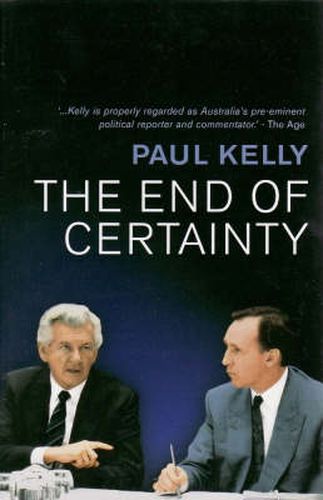
The End of Certainty is a classic study of power, personality and national destiny. From boom to recession, Hawke to Keating, and Labor’s victory for the ‘true believers’ in 1993, Paul Kelly has written the ultimate inside story of how the 1980s changed Australia and its political parties forever.
His detailed scrutiny of the inner working of the Hawke-Keating partnership and its slow disintegration, his unravelling of the crippling rivalries for the Liberal Party leadership and his burrowing into cabinet room struggles over the deregulation of Australia’s financial system reveal the brutal realities of Australian politics and how it is played at the very top. But above all, he reminds us of the sheer pace of economic and social change the country lived through and the wake of uncertainty it left behind.
Joining The Hawke Ascendancy, this second instalment in Paul Kelly’s analysis of modern Australian politics, remains as compelling and incisive as when it was first written.
$9.00 standard shipping within Australia
FREE standard shipping within Australia for orders over $100.00
Express & International shipping calculated at checkout
Stock availability can be subject to change without notice. We recommend calling the shop or contacting our online team to check availability of low stock items. Please see our Shopping Online page for more details.
The End of Certainty is a classic study of power, personality and national destiny. From boom to recession, Hawke to Keating, and Labor’s victory for the ‘true believers’ in 1993, Paul Kelly has written the ultimate inside story of how the 1980s changed Australia and its political parties forever.
His detailed scrutiny of the inner working of the Hawke-Keating partnership and its slow disintegration, his unravelling of the crippling rivalries for the Liberal Party leadership and his burrowing into cabinet room struggles over the deregulation of Australia’s financial system reveal the brutal realities of Australian politics and how it is played at the very top. But above all, he reminds us of the sheer pace of economic and social change the country lived through and the wake of uncertainty it left behind.
Joining The Hawke Ascendancy, this second instalment in Paul Kelly’s analysis of modern Australian politics, remains as compelling and incisive as when it was first written.
Search our extensive online catalogue.
