Readings Newsletter
Become a Readings Member to make your shopping experience even easier.
Sign in or sign up for free!
You’re not far away from qualifying for FREE standard shipping within Australia
You’ve qualified for FREE standard shipping within Australia
The cart is loading…


This title is printed to order. This book may have been self-published. If so, we cannot guarantee the quality of the content. In the main most books will have gone through the editing process however some may not. We therefore suggest that you be aware of this before ordering this book. If in doubt check either the author or publisher’s details as we are unable to accept any returns unless they are faulty. Please contact us if you have any questions.
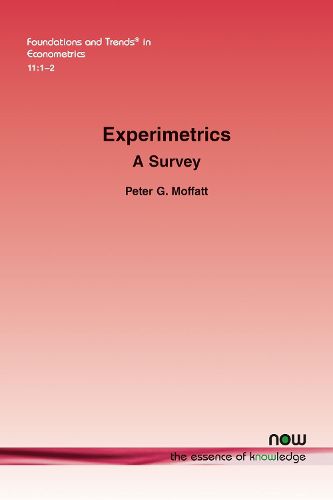
Experimetrics comprises the body of econometric techniques that are customized to experimental applications. This monograph is aimed principally at two types of reader – the experimental economist who is interested in expanding their skill set in econometric techniques and the econometrician interested in the econometric techniques currently being used by experimentalists. Of particular interest to the latter reader may be the techniques that have not traditionally been part of the standard econometrics toolkit like power analysis and optimal experimental design. Experimetrics: A Survey allows for the cross-fertilization of ideas from applied and theoretical econometrics resulting in new and improved techniques in Experimetrics. The purpose of this monograph is to survey these techniques. However, it aims to be more than just a survey of the literature because it also aims to explain the techniques and evaluate them with illustrations, sometimes using data sets from previously published studies. Section 2 provides an overview of treatment testing. Section 3 covers power analysis. Section 4 covers the different types of data arising in Experimental Economics, and the reasons why they arise in the form they do. The remainder of the monograph is concerned mainly with the estimation of fully structural models. Section 5 considers methods for the structural estimation of social preference parameters. Section 6 considers ways of dealing with continuous heterogeneity. Section 7 considers finite mixture models as a way of capturing discrete heterogeneity. Section 8 considers other models of behavior in games, including the Quantal Response Equilibrium (QRE) Model. Section 9 considers models of Learning. Conclusions are found in Section 10.
$9.00 standard shipping within Australia
FREE standard shipping within Australia for orders over $100.00
Express & International shipping calculated at checkout
Stock availability can be subject to change without notice. We recommend calling the shop or contacting our online team to check availability of low stock items. Please see our Shopping Online page for more details.
This title is printed to order. This book may have been self-published. If so, we cannot guarantee the quality of the content. In the main most books will have gone through the editing process however some may not. We therefore suggest that you be aware of this before ordering this book. If in doubt check either the author or publisher’s details as we are unable to accept any returns unless they are faulty. Please contact us if you have any questions.
Experimetrics comprises the body of econometric techniques that are customized to experimental applications. This monograph is aimed principally at two types of reader – the experimental economist who is interested in expanding their skill set in econometric techniques and the econometrician interested in the econometric techniques currently being used by experimentalists. Of particular interest to the latter reader may be the techniques that have not traditionally been part of the standard econometrics toolkit like power analysis and optimal experimental design. Experimetrics: A Survey allows for the cross-fertilization of ideas from applied and theoretical econometrics resulting in new and improved techniques in Experimetrics. The purpose of this monograph is to survey these techniques. However, it aims to be more than just a survey of the literature because it also aims to explain the techniques and evaluate them with illustrations, sometimes using data sets from previously published studies. Section 2 provides an overview of treatment testing. Section 3 covers power analysis. Section 4 covers the different types of data arising in Experimental Economics, and the reasons why they arise in the form they do. The remainder of the monograph is concerned mainly with the estimation of fully structural models. Section 5 considers methods for the structural estimation of social preference parameters. Section 6 considers ways of dealing with continuous heterogeneity. Section 7 considers finite mixture models as a way of capturing discrete heterogeneity. Section 8 considers other models of behavior in games, including the Quantal Response Equilibrium (QRE) Model. Section 9 considers models of Learning. Conclusions are found in Section 10.
Search our extensive online catalogue.
