Readings Newsletter
Become a Readings Member to make your shopping experience even easier.
Sign in or sign up for free!
You’re not far away from qualifying for FREE standard shipping within Australia
You’ve qualified for FREE standard shipping within Australia
The cart is loading…


This title is printed to order. This book may have been self-published. If so, we cannot guarantee the quality of the content. In the main most books will have gone through the editing process however some may not. We therefore suggest that you be aware of this before ordering this book. If in doubt check either the author or publisher’s details as we are unable to accept any returns unless they are faulty. Please contact us if you have any questions.
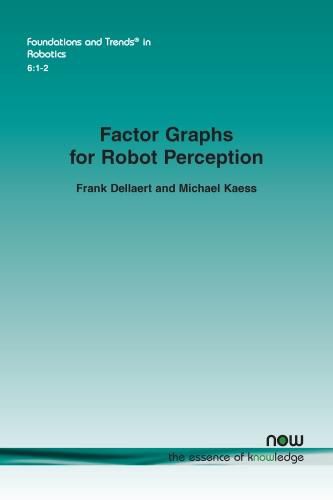
Factor Graphs for Robot Perception reviews the use of factor graphs for the modeling and solving of large-scale inference problems in robotics. Factor graphs are a family of probabilistic graphical models, other examples of which are Bayesian networks and Markov random fields, well known from the statistical modeling and machine learning literature. They provide a powerful abstraction that gives insight into particular inference problems, making it easier to think about and design solutions, and write modular software to perform the actual inference. This book illustrates their use in the simultaneous localization and mapping problem and other important problems associated with deploying robots in the real world. Factor graphs are introduced as an economical representation within which to formulate the different inference problems, setting the stage for the subsequent sections on practical methods to solve them. The book explains the nonlinear optimization techniques for solving arbitrary nonlinear factor graphs, which requires repeatedly solving large sparse linear systems. Factor Graphs for Robot Perception will be of interest to students, researchers and practicing roboticists with an interest in the broad impact factor graphs have had, and continue to have, in robot perception.
$9.00 standard shipping within Australia
FREE standard shipping within Australia for orders over $100.00
Express & International shipping calculated at checkout
Stock availability can be subject to change without notice. We recommend calling the shop or contacting our online team to check availability of low stock items. Please see our Shopping Online page for more details.
This title is printed to order. This book may have been self-published. If so, we cannot guarantee the quality of the content. In the main most books will have gone through the editing process however some may not. We therefore suggest that you be aware of this before ordering this book. If in doubt check either the author or publisher’s details as we are unable to accept any returns unless they are faulty. Please contact us if you have any questions.
Factor Graphs for Robot Perception reviews the use of factor graphs for the modeling and solving of large-scale inference problems in robotics. Factor graphs are a family of probabilistic graphical models, other examples of which are Bayesian networks and Markov random fields, well known from the statistical modeling and machine learning literature. They provide a powerful abstraction that gives insight into particular inference problems, making it easier to think about and design solutions, and write modular software to perform the actual inference. This book illustrates their use in the simultaneous localization and mapping problem and other important problems associated with deploying robots in the real world. Factor graphs are introduced as an economical representation within which to formulate the different inference problems, setting the stage for the subsequent sections on practical methods to solve them. The book explains the nonlinear optimization techniques for solving arbitrary nonlinear factor graphs, which requires repeatedly solving large sparse linear systems. Factor Graphs for Robot Perception will be of interest to students, researchers and practicing roboticists with an interest in the broad impact factor graphs have had, and continue to have, in robot perception.
Search our extensive online catalogue.
